|
Voigtlander APO-Lanthar 90mm f/3.5 SL (Nikon) - Review / Test Report - Analysis |
|
Lens Reviews -
Nikon / Nikkor (APS-C)
|
|
Page 2 of 3
Distortion
Unsurprisingly the Voigtlander produces only a negligible degree (0.2%) of
pincushion distortion which is not field-relevant.
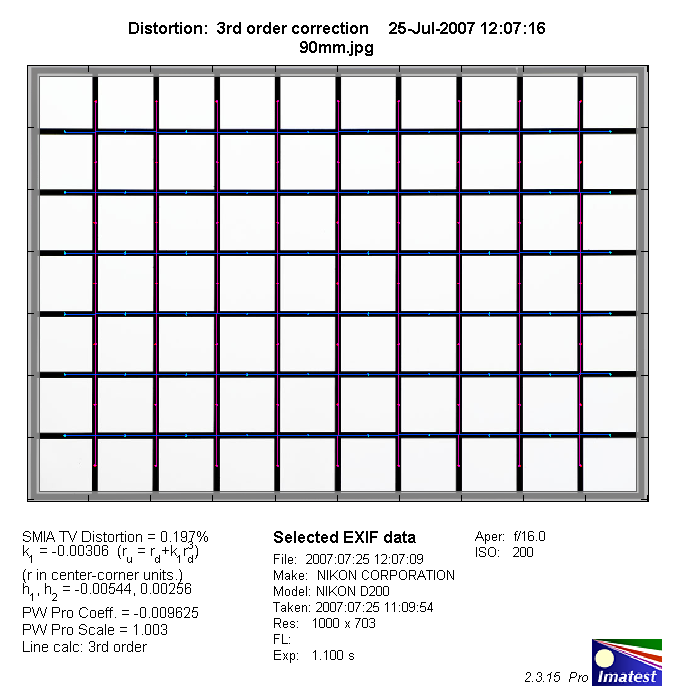
The chart above has a real-world size of about 120x80cm.
Vignetting
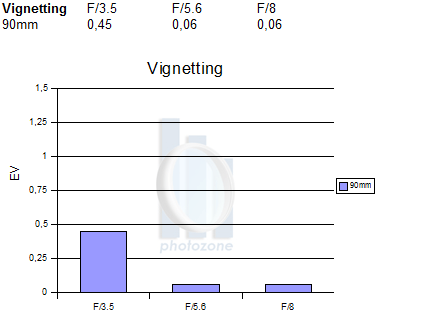
The APO-Lanthar is a full format lens and as such it enjoys the usual sweet
spot advantage when used on APS-C DSLRs. Within this scope the lens shows only a slight
degree of vignetting at f/3.5 and from f/5.6 onwards it's a non-issue.
MTF (resolution)
The Voigtlander is a fairly unambitious lens - it is a moderate tele lens with
a comparatively slow max. aperture yet it takes advantage of one "APO" element.
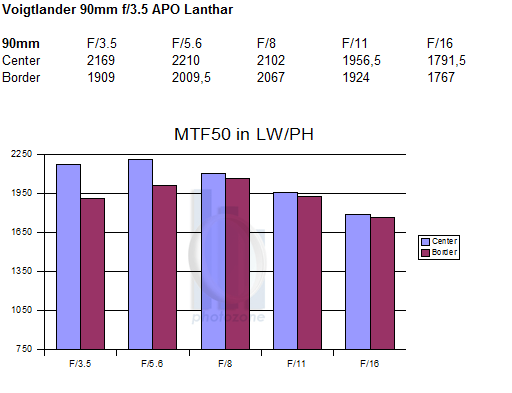
Correspondingly the resolution characteristic is on a very high level straight
from f/3.5. The center resolution is excellent here and the borders follow on
very good levels. At f/5.6 the center reaches its peak and the borders
improve to excellent quality. The lens shows its best borders performance at f/8.
Diffraction effects reduce the quality from f/11 onwards.
Please note that the MTF results are not directly comparable across the different systems!
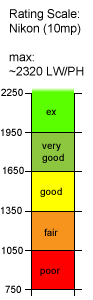
Below is a simplified summary of the formal findings. The chart shows line widths per picture height (LW/PH) which can be taken as a measure for sharpness.
If you want to know more about the MTF50 figures you may check out the corresponding Imatest Explanations
Chromatic Aberrations (CAs)
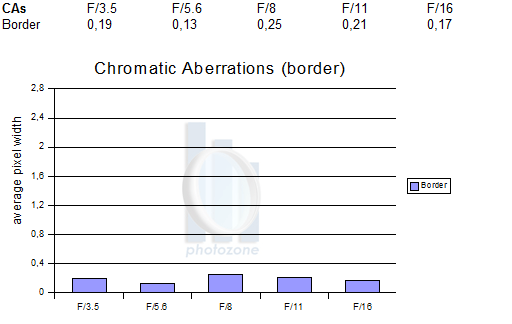
Typical for Voigtlander lenses CAs (color shadows at strong contrast transitions)
are basically a non-issue and not field-relevant.
Purple Fringing
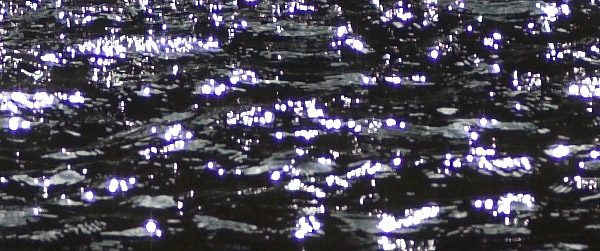
The 90mm f/3.5 is not fully resistant against purple fringing (a blooming effect
at extreme contrast transitions) although the problem is still comparatively
well controlled. Here's a 100% sample crop showing some water reflections:
|