|
Samyang 85mm f/1.4 Aspherical (EOS) - APS-C format Review / Lab Test - Analysis |
|
Lens Reviews -
Canon EOS (APS-C)
|
|
Page 2 of 2

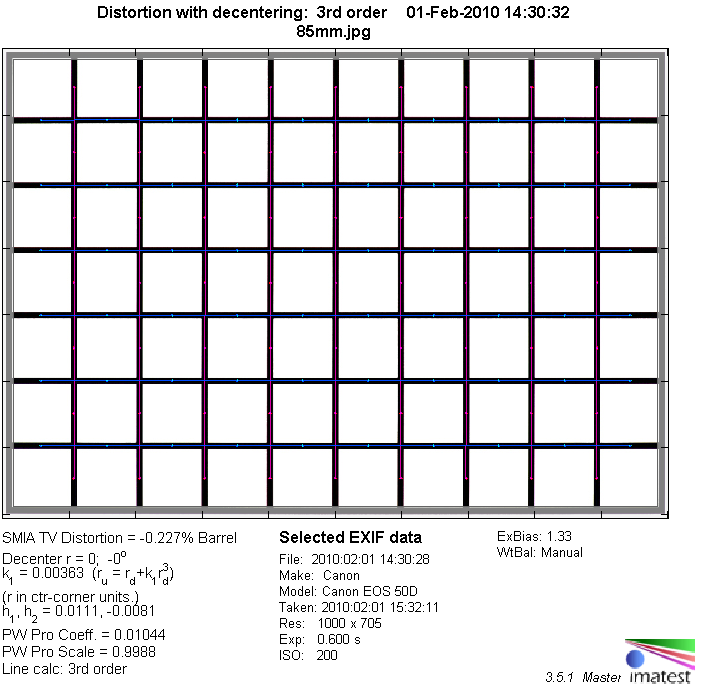
Distortion
The Samyang produces only a marginal degree of barrel distortion (~0.2%) which is nothing to worry about in field conditions.
Vignetting
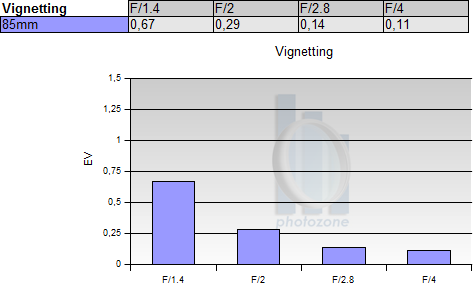
As a full format lens the 85mm f/1.4 is enjoying a sweet spot advantage when used on APS-C DSLRs. At f/1.4 you may still notice a light falloff of ~0.7EV (f-stops). This may be just noticeable in critical scenes. Stopping down to f/2 resolves the problem from a field perspective.
MTF (resolution)
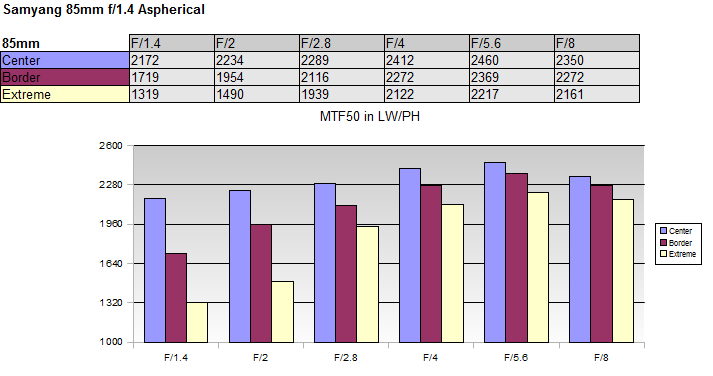
The resolution characteristic of the Samyang lens is very decent but not without flaws. At max. aperture it is capable of producing sharp results in the image center whereas the border quality is "only" good and the corners are quite soft here. The contrast level is somewhat reduced here as well. The border and corner quality increases quite a bit at f/2 already and it reaches good to very good levels at f/2.8. At f/4 the resolution is very good across the image frame. The peak performance is reached around f/5.6 with both an excellent center as well as the borders. The extreme corners are easily very good here. Diffraction effects have a very slight impact at f/8. There's only a very slight amount of field curvature.
Please note that the MTF results are not directly comparable across the different systems!
Below is a simplified summary of the formal findings. The chart shows line widths per picture height (LW/PH) which can be taken as a measure for sharpness.
If you want to know more about the MTF50 figures you may check out the corresponding Imatest Explanations
Lateral Chromatic Aberrations (CAs)
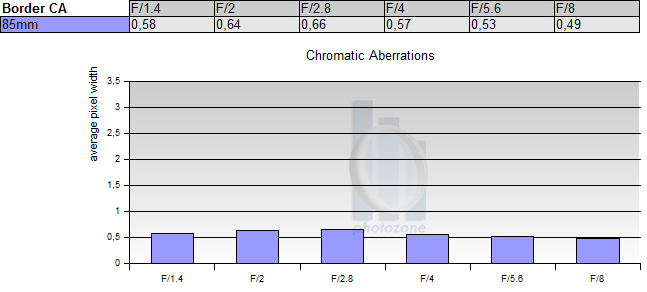
It may be surprising but the Samyang has shows only minor lateral chromatic aberrations. An average CA width of around 0.6px at the borders is not really field-relevant anymore.
Bokeh
The bokeh (the quality of the out-of-focus blur) is a primary aspect for an ultra large aperture lens and the Samyang does a good job here. In fact the quality of out-of-focus highlights is pretty much perfect - at least at f/1.4 and f/2. The lens has no circular aperture blades and the more angled projection gets somewhat more visible from f/2.8 onwards.
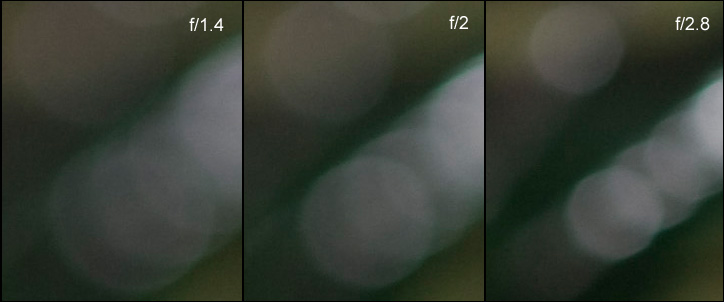
The quality of the general blur is very smooth. However, you may spot the purple halo on the very last image - that's "bokeh fringing" (see the next chapter).
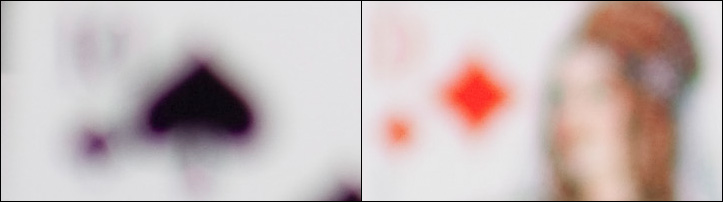
Bokeh Fringing / Longitudinal Chromatic Aberrations (LoCA)
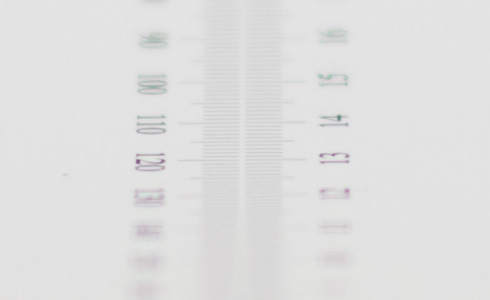
Bokeh fringing is a common problem in this lens class and the Samyang suffers as well here - like the vast majority of lenses it is no "APO" design. If you look at the provided sample crops below you should be able to spot a purple halo in front of the focus zone and a green one beyond. This is clearly visible at f/1.4 till f/2.8. The problem starts to fade from f/4 onwards.
You may also spot a slight focus shift towards the background when stopping down ("residual spherical aberrations").
|
Move the mouse cursor over the f-stop marks below to observe the respective LoCAs
|
| f/1.4 |
f/2 |
f/2.8 |
f/4 |
|
|
Verdict
The Samyang 85mm f/1.4 Aspherical may be a very affordable lens but it's a very decent performer nevertheless. It is capable of delivering a very good center performance at f/1.4 although it's fairly soft in the image corners at this setting. The contrast level could be a tad better here as well. The global quality is pretty good at f/2.8 and impressive from f/4 onwards. At f/5.6 it is as good as the very best lenses out there. Lateral CAs are very well controlled which contributes to the very high sharpness perception at medium apertures. You may spot a little light falloff at f/1.4 but it's a non-issue beyond. The level of distortion is minimal as well. The bokeh is surprisingly smooth although strong bokeh fringing (LoCA) can be an issue at times. However, this is rather typical for such ultra-large aperture lenses regardless of the manufacturer.
The Samyang 85mm f/1.4 Aspherical started a new era for the company a few years ago. It was the beginning of a path away from an exotic niche manufacturer towards the mainstream. Samyang may not be there yet - primarily due to the lack of AF - but this simply takes a while. If you can live with the manual aperture and manual focus the Samyang 85mm f/1.4 (as well as is cousins) is certainly worth a serious consideration. After all it costs just a fraction of a "conventional" AF 85mm f/1.4 so it's also within reach of more budget-oriented users. Remember also that the "native" Canon EF 85mm f/1.8 USM may be a tad "slower" but it resides in the same price league.
| Optical Quality: |
 |
|
|
| Field Quality: |  (Shallow Depth-of-Field Photography) (Shallow Depth-of-Field Photography) |
| Mechanical Quality: | |
| Price/Performance: |  |
| | |
| | What does this mean ? |
|


