|
Pentax SMC DA 18-250mm f/3.5-6.3 ED AL [IF] - Review / Lab Test Report - Analysis |
|
Lens Reviews -
Pentax
|
|
Page 2 of 2

Distortion
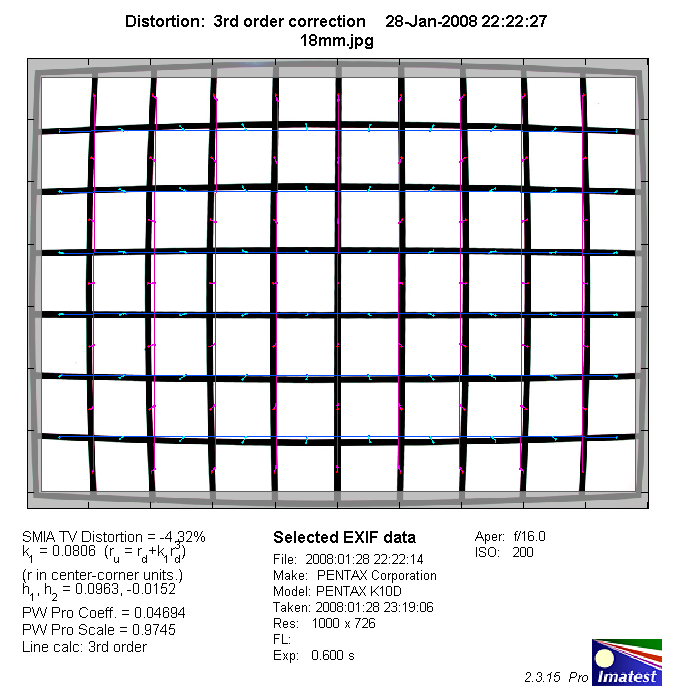
Typical for extreme range zooms the Pentax lens exhibits a fairly hefty amount of barrel
distortion at 18mm (~4.3%). However, beyond the wide end the problem is actually
very well controlled with only slight to moderate pincushion distortion.
|
Move the mouse cursor over the focal length text marks below to observe the respective distortion
|
| 18mm |
35mm |
70mm |
135mm |
250mm |
|
The chart above has a real-world size of about 120x80cm.
Vignetting
As mentioned the Pentax lens has been designed to cover the APS-C image circle only which
makes perfect sense for Pentax DSLRs anyway. This characteristic combined with the extreme zoom
ratio is a bit of a troublesome situation when it comes to vignetting specifically at
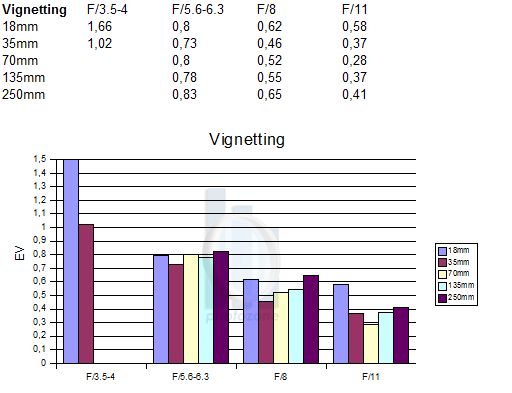
the wide end of the zoom range. At 18mm @ f/3.5 the amount of vignetting is fairly extreme
(~1.7EV) - obviously a setting which should be generally avoided. However, this is the
worst spot - it's much better at other focal lengths and the situation is generally acceptable
by f/5.6 and decent around f/8.
MTF (resolution)
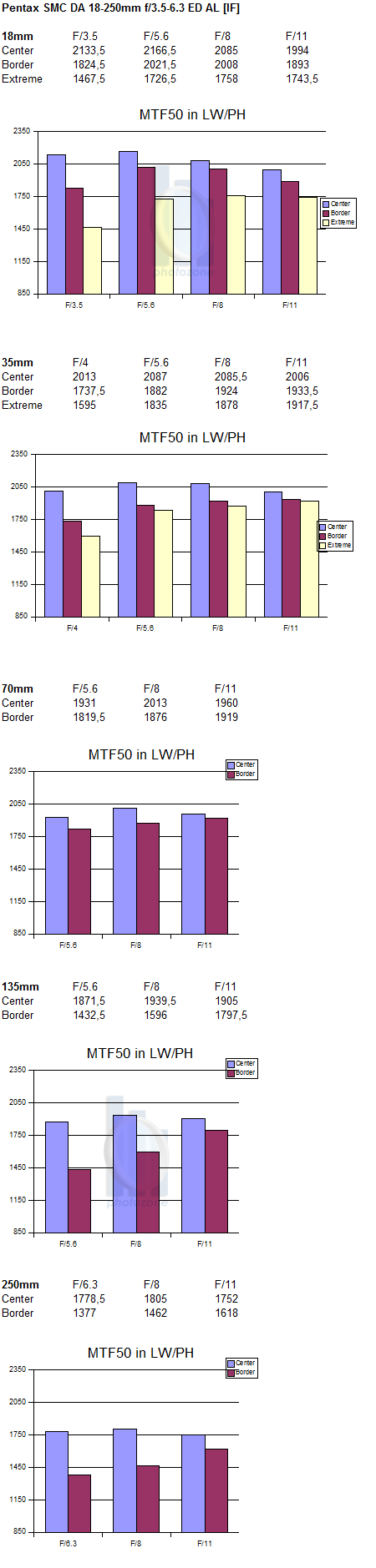
Generally the Pentax 18-250mm produced comparatively decent resolution figures in the MTF lab.
The sweet range of the lens is clearly below 100mm. At 18mm up to 70mm the results are very good
and even comparable to conventional standard zoom lenses which is fairly amazing for such a lens.
At 18mm and 35mm you should avoid the max. aperture setting in order to overcome some border
softness here but from f/5.6 onwards there isn't really much to complain in terms of resolution.
The situation changes when looking at longer focal lengths. At 135mm and more so at 250mm there's a
quite a drop in quality. The center performance remains fairly intact with good to very good results
but the border quality is soft at max. aperture - the contrast level is also generally reduced here.
Stopping down to f/8 or better f/11 boosts the border quality. The 250mm remains the weakest setting
though but this can't really come as a surprise.
The results are slightly worse compared to the Tamron tests in the Nikon/Canon section. Partially
this has to do with the different environments (due to the different AA-filter characteristic
the Pentax charts emphasize higher/lower resolutions) but the manufacturing quality of the tested
sample was also slightly worse compared to the two Tamrons. Such extreme zoom lenses are generally
suffering from quality variations anyway so this is not necessarily a trend here.
Please note that the MTF results are not directly comparable across the different systems!
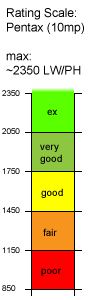
Below is a simplified summary of the formal findings. The chart shows line widths per picture height (LW/PH) which can be taken as a measure for sharpness.
If you want to know more about the MTF50 figures you may check out the corresponding Imatest Explanations
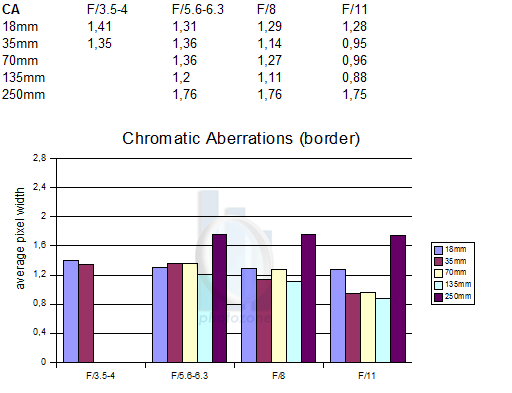
Chromatic Aberrations (CAs)
Lateral CAs (color shadows at harsh contrast transitions) are already an issue for conventional
standard zoom lenses so it doesn't come as a surprise that the Pentax 18-250mm has its fair
share of problems here. That said the results are comparatively well controlled for most of the
range with an average CA pixel width between 1-1.5px at the image borders. The worst spot is reached
at 250mm and about 1.75px of CAs which is fairly hefty for this setting.
VerdictThe Pentax SMC DA 18-250mm f/3.5-6.3 ED AL [IF] is a worthy representative of its species. Naturally
it is not comparable to more specialized zoom lenses, not to mention fix-focals, but within its
scope it does a good job. This is especially true for the range below 100mm where its resolution
can match many conventional zoom lenses. At 18mm the vignetting and distortion figures are fairly extreme
though. At 135mm and more so at 250mm there's a drop in performance specifically at the max.
aperture setting which should be generally avoided here. Lateral CAs are fairly well controlled
except at the long end of the zoom range. The build quality of the lens is up to the usual Pentax DA
standards which is a good thing. All-in-all a decent and affordable travel zoom lens but, unsurprisingly,
not a lens for high performance lovers.
| Optical Quality: |  (a better copy would get (a better copy would get  ) ) |
| Mechanical Quality: |  |
| Price/Performance: |  |
|