|
Pentax DA 12-24mm f/4 AL ED [IF] - Review / Test Report - Analysis |
|
Lens Reviews -
Pentax
|
|
Page 2 of 3
Distortion
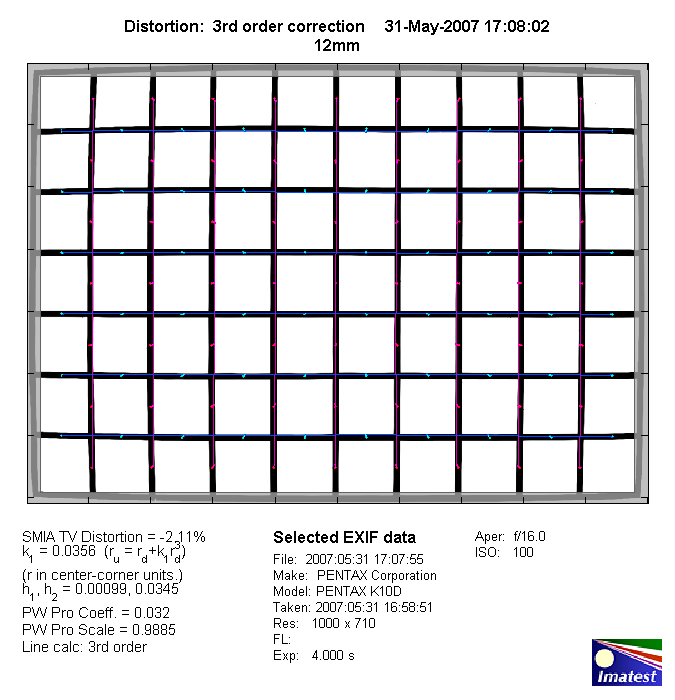
The Pentax DA 12-24mm shows a pretty good distortion characteristic for an ultra-wide
zoom lens. At 12mm there's a relatively pronounced degree of slightly wavy barrel
distortion (~2.1%) which decreases continuously when zooming towards the long end of
the zoom range where the lens is basically free of distortion.
|
Move the mouse cursor over the focal length text marks below to observe the respective distortion
|
| 12mm |
18mm |
24mm |
|
|
The chart above has a real-world size of about 120x80cm.
Vignetting
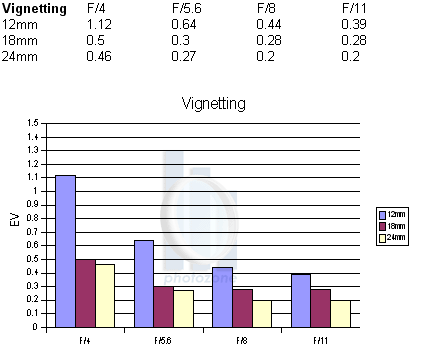
At 12mm @ f/4 the lens shows fairly strong vignetting (~1.1EV) which will be visible in some scenes.
However, from f/5.6 onwards the problem is already largely reduced and generally harmless in
field conditions. At 18mm and 24mm the amount of vignetting is far less pronounced even at
wide-open aperture.
MTF (resolution)
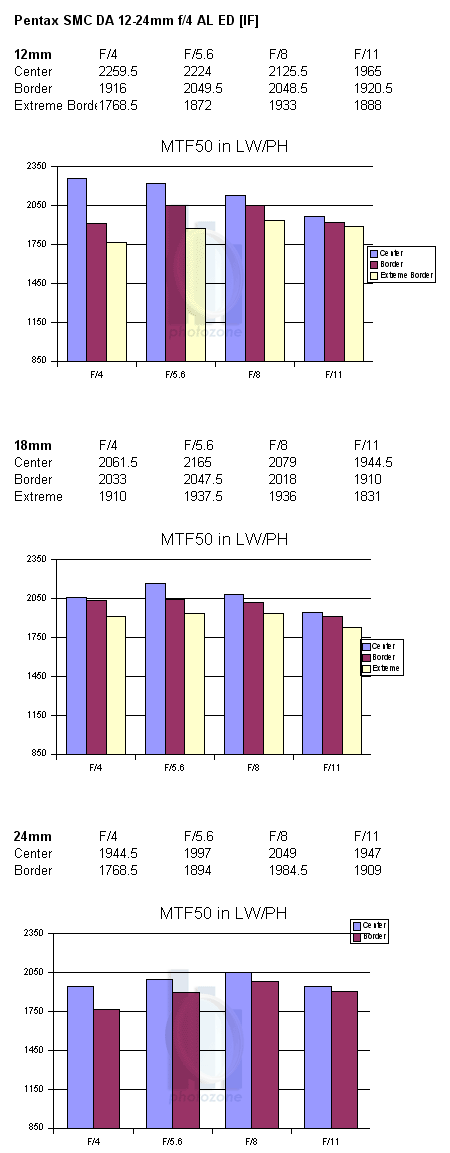
The Pentax produced pretty impressive resolution figures in the MTF lab. Unlike many other lenses with a
reduced image circle it is capable to combine a generally excellent center performance with very good
borders as well as very good extreme corners. The center performance decreases slightly when zooming
towards "longer" focal lengths whereas the border quality remains more or less constant.
The contrast is slightly reduced at 24mm @ f/4 but it's already fine when stopped down to f/5.6.
The field curvature is quite moderate.
Please note that the MTF results are not directly comparable across the different systems!
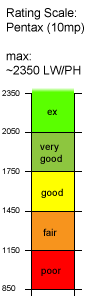
Below is a simplified summary of the formal findings. The chart shows line widths per picture height (LW/PH) which can be taken as a measure for sharpness.
If you want to know more about the MTF50 figures you may check out the corresponding Imatest Explanations
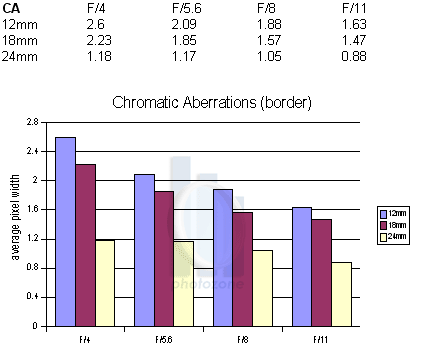
Chromatic Aberrations (CAs)
CAs (color shadows at harsh contrast transitions) are the primary weakness of the Pentax lens
(just like in the Tokina variant). At 12mm and 18mm CAs peak way beyond 2px on the average at
the image borders. Stopping down helps to reduce the problem but it's still high at f/8.
At 24mm the situation eases somewhat.
Please note that CAs can be largely corrected via imaging tools such as Adobe Photoshop.
|