|
Pentax SMC-DA 14mm f/2.8 ED [IF] - Review / Test Report - Analysis |
|
Lens Reviews -
Pentax
|
|
Page 2 of 3

MTF (resolution)
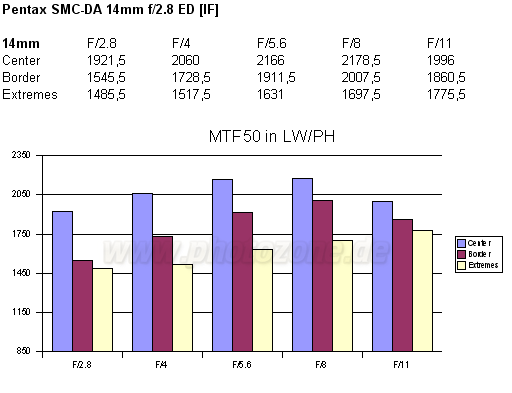
The DA 14mm f/2.8 produced very decent resolution figures for an ultra-wide lens.
The center resolution is already high at f/2.8 whereas the borders and the extreme corners
are only on a good level (just). Stopping down boosts the center and border quality
but the extreme corners recover only slowly. The peak resolution is reached at f/8 to f/11
with an excellent center and very good borders. The field curvature a bit wavy but
comparatively low for a lens in this class.
Please note that the MTF results are not directly comparable across the different systems!
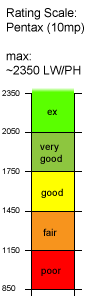
Below is a simplified summary of the formal findings. The chart shows line widths per picture height (LW/PH) which can be taken as a measure for sharpness.
If you want to know more about the MTF50 figures you may check out the corresponding Imatest Explanations
Distortion
Formally the DA 14mm f/2.8 produces only a moderate degree of barrel distortion (~1.7%) - this
is a very low value for an ultra-wide angle lens. Looking a little closer this is only part of
the story because there's also a wavy sub-frequency (also known as mustache distortion).
The test chart does only cover about 90% of the image field. Usually this doesn't have much of
an impact but the Pentax lens manages to change its distortion to fairly a pronounced pincushion
characteristic here. This is a somewhat odd behavior.
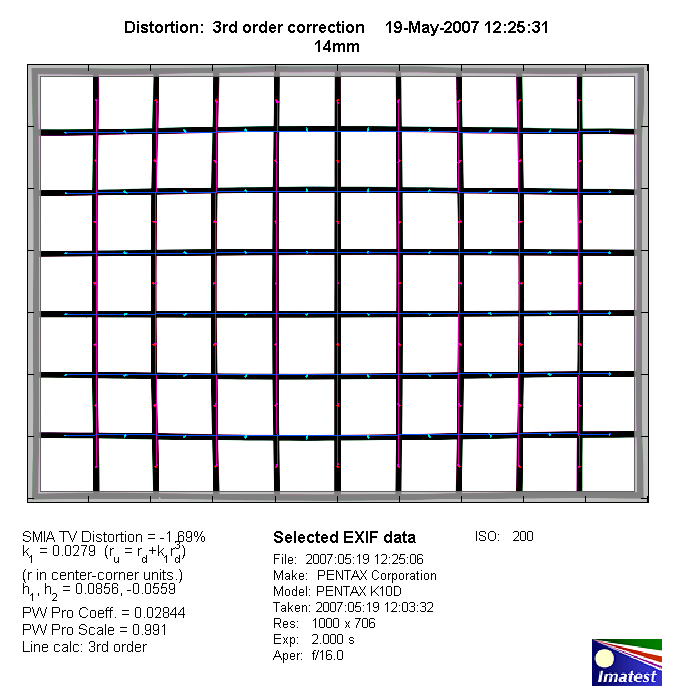
The chart above has a real-world size of about 120x80cm.
Vignetting
The DA 14mm f/2.8 is a dedicated APS-C lens and being a large aperture ultra-wide lens doesn't
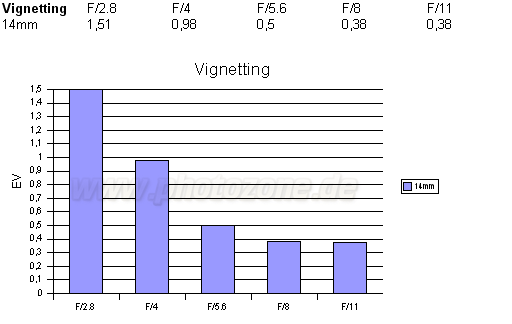
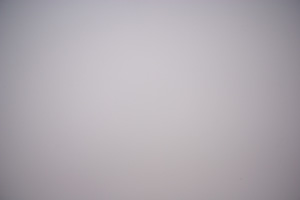
make things any easier regarding vignetting. At f/2.8 the lens produces a hefty amount of
vignetting (~1.5EV) which will be visible in many situations. The situation improves a bit
at f/4 but it takes f/5.6 till the problem gets fairly negligible.
Here's a sample image (of a blank white sheet overexposed by +1EV) taken at f/2.8:
Chromatic Aberrations (CAs)
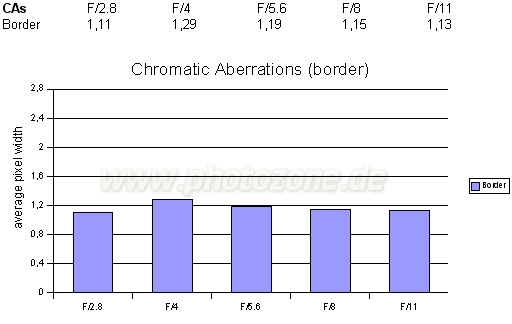
Lateral chromatic aberrations (color shadows at harsh contrast transitions) are
fairly well controlled for a lens in this focal length class. The average CA width
at the image borders varies around 1.2px which will be visible at times.
In the field I've also seen a some traces of purple fringing.
(Note: Lateral CAs can be reduced via imaging tools)
|