|
Leica D Vario-Elmar 14-50mm f/3.8-5.6 Asph. OIS - Review / Test Report - Analysis |
|
Lens Reviews -
(Micro-)Four-Thirds
|
|
Page 2 of 3
Distortion
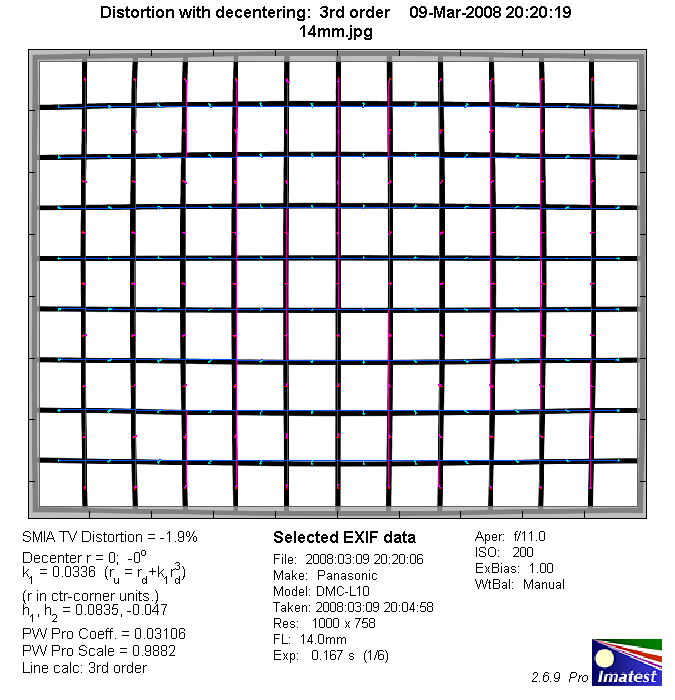
The Vario-Elmar has a quite moderate distortion characteristic - at 14mm it produces
a medium degree of barrel distortion (1.9%) which eases towards the longer focal lengths.
There is virtually no distortion from 35mm onwards. That's pretty good for a standard
zoom lens actually.
|
Move the mouse cursor over the focal length text marks below to observe the respective distortion
|
| 14mm |
18mm |
35mm |
50mm |
|
The chart above has a real-world size of about 120x80cm.
Vignetting
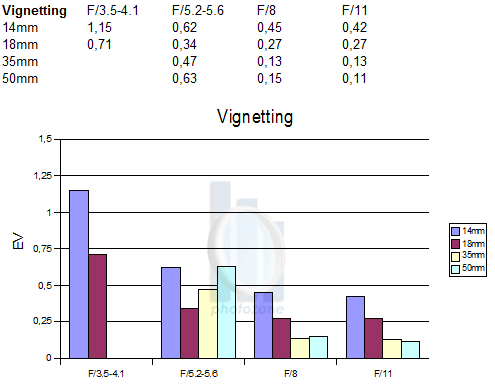
Vignetting is a problem at 14mm @ f/3.8 - a loss of 1.15EV is nothing to rave about here.
At f/5.6 there's still a bit of vignetting left at 14mm and 50mm but at around 0.6EV you don't need
to worry about it anymore except in very critical situations. At other settings vignetting is no
longer field relevant.
MTF (resolution)
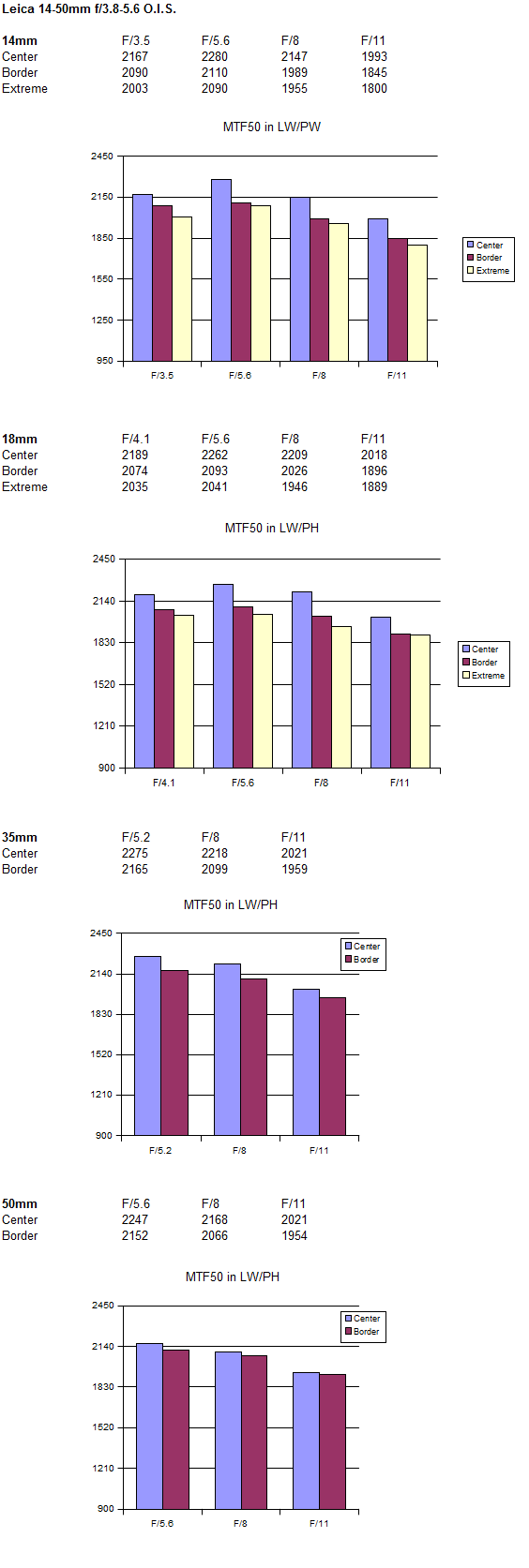
This is the very first lens test performed on the Panasonic L10 so the jury is still out
regarding its resolution capabilities. However, it is probably quite safe to state that the
Vario-Elmar is a very decent performer with a very high performance throughout the entire
zoom range. You may notice the very even center to corner performance straight from the max.
aperture and the marginal quality decrease towards 50mm.
However, we'll need to have a look at a fix-focal like the Olympus 50mm f/2 to put all this
into perspective.
Please note that the MTF results are not directly comparable across the different systems!
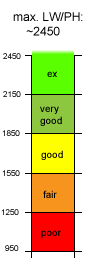
Below is a simplified summary of the formal findings. The chart shows line widths per picture height (LW/PH) which can be taken as a measure for sharpness.
If you want to know more about the MTF50 figures you may check out the corresponding Imatest Explanations
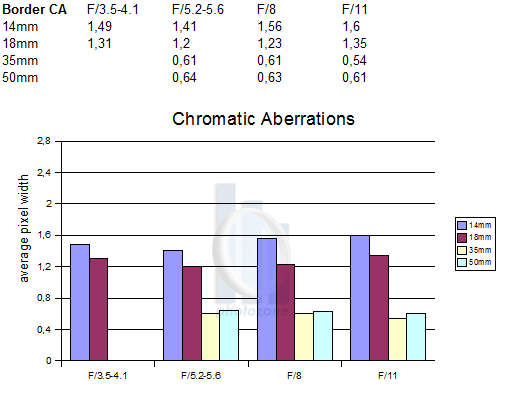
Chromatic Aberrations (CAs)
Lateral chromatic aberrations (color shadows at harsh contrast transitions) are
quite pronounced at wide end of the zoom range. Regarding an average width around 1.5px at the
image borders the problem can be visible in some scenes (including reduced sharpness perception).
The problem eases towards longer focal lengths and it's well controlled starting somewhere in
the middle range.
|