|
Tamron AF 18-250mm f/3.5-6.3 Di II LD Aspherical [IF] macro (Nikon) - Review / Lab Test Report |
|
Lens Reviews -
Nikon / Nikkor (APS-C)
|
|
Page 1 of 2
Review by Klaus Schroiff, published June 2007
Lens kindly provided by Tamron Europe!
Introduction
Back in the 1992 Tamron started the extreme or "super" zoom era with the release of the
the AF 28-200mm F/3.8-5.6 Aspherical, a 7.1x zoom ratio lens. At the time it was quite a
sensation whereas today such lenses have found their way into the heart of the mainstream.
Tamron released various new incarnations over time including the 28-300mm (10.7x) and the
first dedicated APS-C super-zoom - the 18-200mm XR (11.1x) - and this year they pushed
it even further with the new Tamron AF 18-250mm f/3.5-6.3 Di II LD Aspherical [IF] macro
breaking the existing zoom ratio record again (13.9x) - the zoom range translates a
field-of-view equivalent to a 27-375mm (full format). Normally you would expect such
a beast to be fairly massive but Tamron is also renowned for lens miniaturization and
the 18-250mm isn't any bigger than a typical mid-range zoom. One of the reasons for this
is surely the very slow max. aperture of f/6.3 @ 250mm. This is a bit of a borderline approach
because most AF system are only specified till f/5.6 (officially) and you need
quite a bit of light (or high ISO) to use this lens hand-held.
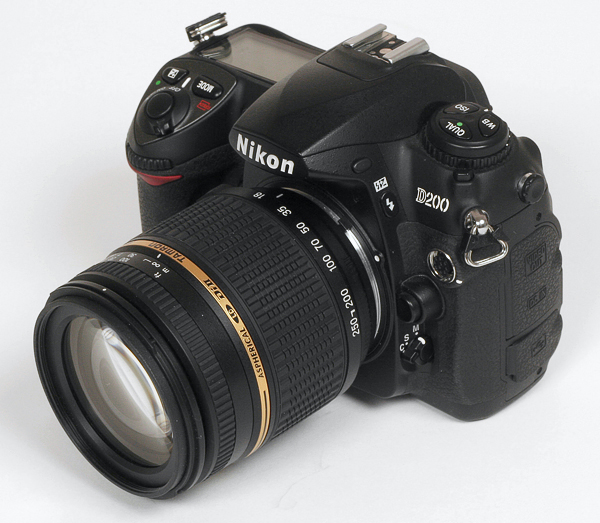
In terms of build quality the Tamron is a fairly typical consumer grade zoom lens.
Most of the outer construction is made of plastic except for the metal mount (which
is an upgrade compared to the old 18-200mm XR). The broad rubberized zoom ring
has a varying friction and it wobbles a little whereas the small focus ring
operates reasonably smooth although somewhat "scratchy". The lens uses a duo-cam zoom
mechanism (two inner lens tubes) to extend towards to long end of the zoom range.
At 250mm the lens is about twice as long as full retracted (@ 18mm). Surprisingly
the duo-cams showed no tendency to wobble despite the extreme extension. The tested
sample did not suffer from zoom creeping (which may develop over time) but Tamron
implemented a transport lock (18mm only) just in case.
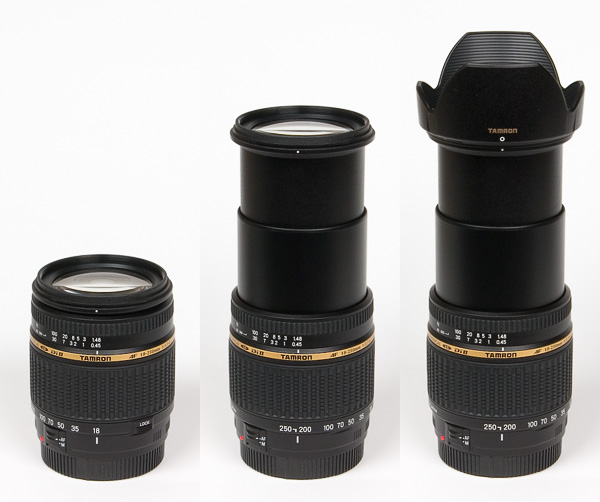
Note: The product image above shows the Canon variant of the lens
The lens has no internal AF motor and relies on a slotted drive screw operated by the
camera. This generates some noise during AF operations and the AF speed is comparatively
slow although reasonably accurate on the D200.
| Specifications |
|---|
| Equiv. focal length | 27-375 mm (full format equivalent) |
| Equiv. aperture | f/5.3-f/9.5 (full format equivalent, in terms of depth-of-field) |
| Optical construction | 16 elements in 13 groups inc. 1x AD, 2x LD and 2x hybrid aspherical elements |
| Number of aperture blades | 7 |
| min. focus distance | 0.45 m (max. magnification ratio ~1:3.5) |
| Dimensions | 84 x 83 mm |
| Weight | 430 g |
| Filter size | 62 mm (non-rotating) |
| Hood | supplied, petal-shaped, snap-on type |
| Other features | - |
|


