|
Tamron 500mm f/8 SP macro (Adaptall-to-Nikon) Review / Test Report - Analysis |
|
Lens Reviews -
Nikon / Nikkor (APS-C)
|
|
Page 2 of 3
Distortion
In practical terms the Tamron mirrors produces only a negligible degree of pincushion
distortion (~0.3%).
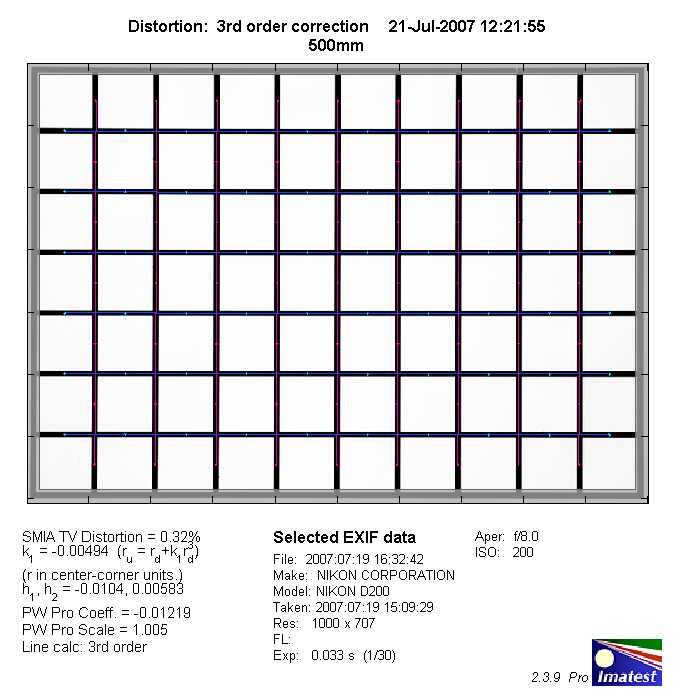
The chart above has a real-world size of about 120x80cm.
Vignetting
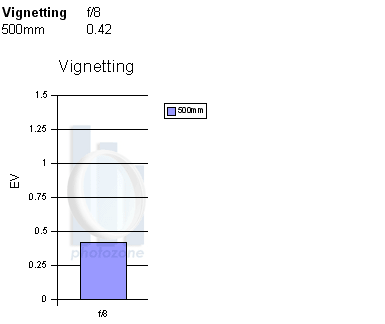
As mentioned mirror lenses offer no variable aperture so the vignetting test is
limited to one reading - the Tamron produces only a slight amount of vignetting at f/8.
MTF (resolution)
Well, not much to see here as well. It was fairly difficult to obtain valid test data.
Besides being a 500mm lens (thus requiring a camera-to-chart distance of 30m) the camera-lens
combination is very light-weight and prone to shaking. Anyway - resolution-wise the
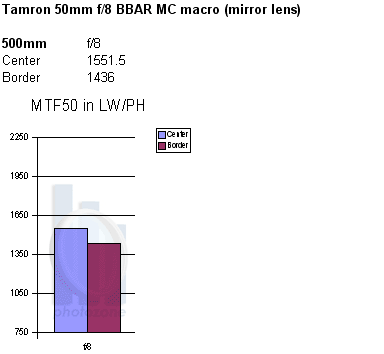
Tamron is capable to produce "good" results. Subjectively the lens is quite a bit softer
at close-focus distances.
Please note that the MTF results are not directly comparable across the different systems!
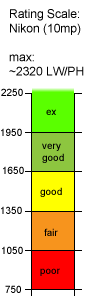
Below is a simplified summary of the formal findings. The chart shows line widths per picture height (LW/PH) which can be taken as a measure for sharpness.
If you want to know more about the MTF50 figures you may check out the corresponding Imatest Explanations
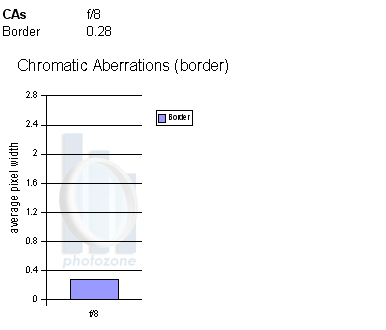
Chromatic Aberrations (CAs)
As already mentioned above the mirror design results in a very low degree of CAs
(color shadows at harsh contrast transitions) which is not field-relevant.
Bokeh (out-of-focus blur)
A major argument against mirror lenses is the quality of the bokeh. The secondary
mirror causes a donut-like effect on out-of-focus highlights. The effect is minimized
or absent in long distance images because of the bigger depth-of-field (thus minimal
out-of-focus blur) or if you can manage to avoid out-of-focus highlights.

|