|
Canon EF 50mm f/1.4 USM - Full Format Review / Lab Test Report - Analysis |
|
Lens Reviews -
Canon EOS (Full Format)
|
|
Page 2 of 2

Distortion
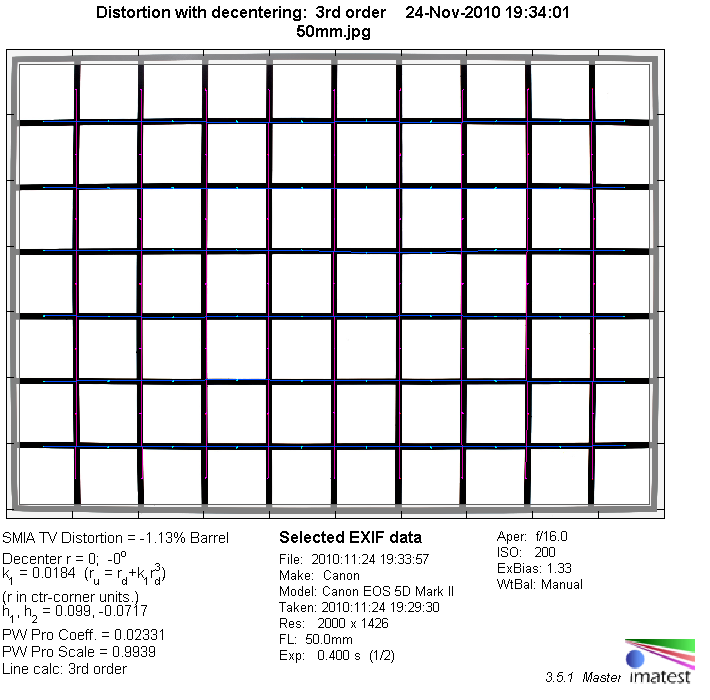
The EF 50mm f/1.4 produces a slight to moderate amount of barrel distortion (1.1%). This is barely noticeable in
field conditions.
Vignetting
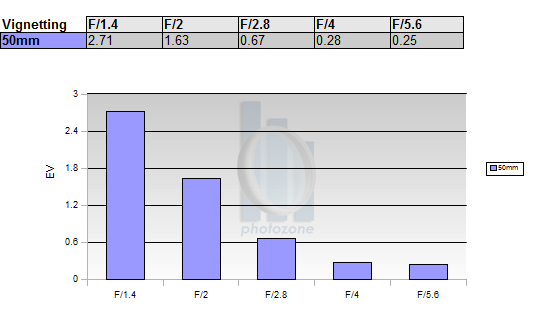
Ultra large aperture lenses have a hard time regarding vignetting when used on full format DSLRs. The EF 50mm f/1.4 USM shows an extremely high amount of light falloff at f/1.4 - a 2.7EV this is disturbing in most images unless you prefer the effect for artistic reasons. The issue improves substantially when stopping down to f/2 but you need to go for f/2.8 or beyond to reduce the light falloff to a degree where it isn't disturbing anymore.
MTF (resolution)
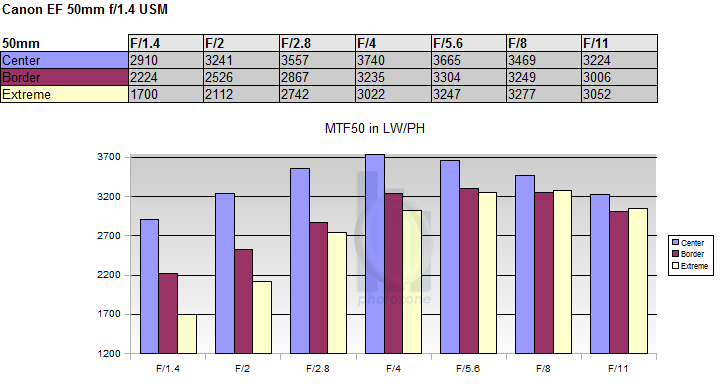
The resolution chart shows a rather wide spread in image quality across the tested aperture range but this is typical for most ultra-large aperture lenses. The center performance is very good at f/1.4 but the borders are just on a good level and the corners are soft. The contrast level is also somewhat reduced especially towards the corners. The situation improves quite a bit when stopping down to f/2 - the center is lifted into excellent level here and the corners start to get acceptable. There's a further boost of the border/corner quality at f/2.8 - the outer region reaches very good figures here (albeit just). The range between f/4 and f/8 represents the sweet spot of the lens with an outstanding center resolution and generally excellent borders and corners. Diffraction effects reduce the global quality from f/11 onwards but this is, of course, a physical limitation and not a design issue of the lens.
Please note that the MTF results are not directly comparable across the different systems!
Below is a simplified summary of the formal findings. The chart shows line widths per picture height (LW/PH) which can be taken as a measure for sharpness.
If you want to know more about the MTF50 figures you may check out the corresponding Imatest Explanations
Chromatic Aberrations (CAs)
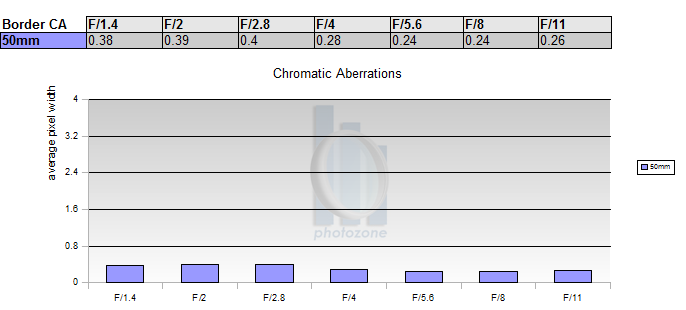
Similar to most other fix-focal lenses chromatic aberrations (color shadows at harsh contrast transitions) are
very low and nothing to worry about.
Bokeh
The bokeh (the quality of the out-of-focus blur) is a primary aspect for an ultra large aperture lens.
The out-of-focus highlights suffer somewhat from vignetting effects at f/1.4 so the shape does
deteriorate somewhat to a "cat's eye" towards the corners. There's also an outlining effect here but the inner
highlight zone is very smooth and uniform. The outlining is slightly improved at f/2 and it's gone by
f/2.8. However, starting at f/2.8 the highlights are no longer circular (thus the aperture is not circular
anymore). The quality of the blur in the critical focus transition zones is quite decent. It's
very smooth towards the foreground and still good (but slightly worse) towards the background.
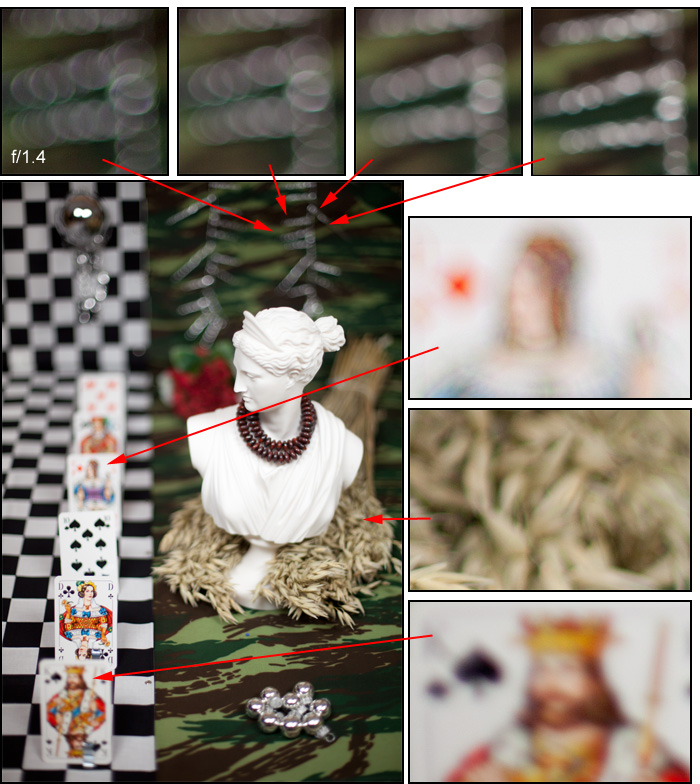
Bokeh Fringing / Longitudinal Chromatic Aberrations (LoCA)
Bokeh fringing is a common problem present in most large aperture lenses and the Canon lens is no
exception to the rule here. If you look at the provided sample crops below you should be able to spot
a purple halo in front of the focus zone and a green one beyond. This is clearly visible at f/1.4 till
f/2. The problem starts to fade at f/2.8 and it's resolved at f/5.6.
|
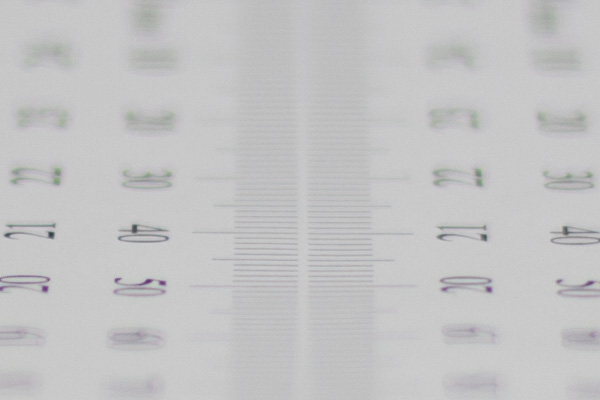
Move the mouse cursor over the f-stop marks below to observe the respective LoCAs
|
| f/1.4 |
f/2 |
f/2.8 |
f/4 |
f/5.6 |
|
|
VerdictIt is no surprise that the Canon EF 50mm f/1.4 USM is a very popular choice among Canon users when it comes to choosing a standard lens. It offers probably the best compromise between quality and price here. That said it's not a flawless lens when used on a full format DSLR. The contrast level is quite a bit reduced at f/1.4 and the corners are soft here. However, the results are good at f/2 and nothing short of great at medium aperture settings. Unfortunately there's an extreme amount of light falloff at max. aperture and it takes two f-stops to reduce the problem to a more or less negligible degree. Lateral CAs are nothing to worry about. The bokeh is generally good but not outstanding. Typical for such lenses there's quite a bit of bokeh fringing (LoCAs) at large apertures. The build quality on a decent level and a step up from the EF 50mm f/1.8 II but it doesn't reach the Sigma AF 50mm f/1.4 EX HSM here. The
micro-USM AF drive operates pretty fast and near silent. All-in-all a sound offer at a sane price.
| Optical Quality: |
 |
|
|
| Field Quality: | (Low Light/Shallow Depth-of-Field Photography) |
| Mechanical Quality: |  |
| Price/Performance: |  |
| | |
| | What does this mean ? |
|