|
Canon EF 28-300mm f/3.5-5.6 USM L IS (full format) - Review / Test Report - Analysis |
|
Lens Reviews -
Canon EOS (Full Format)
|
|
Page 2 of 3

Distortion
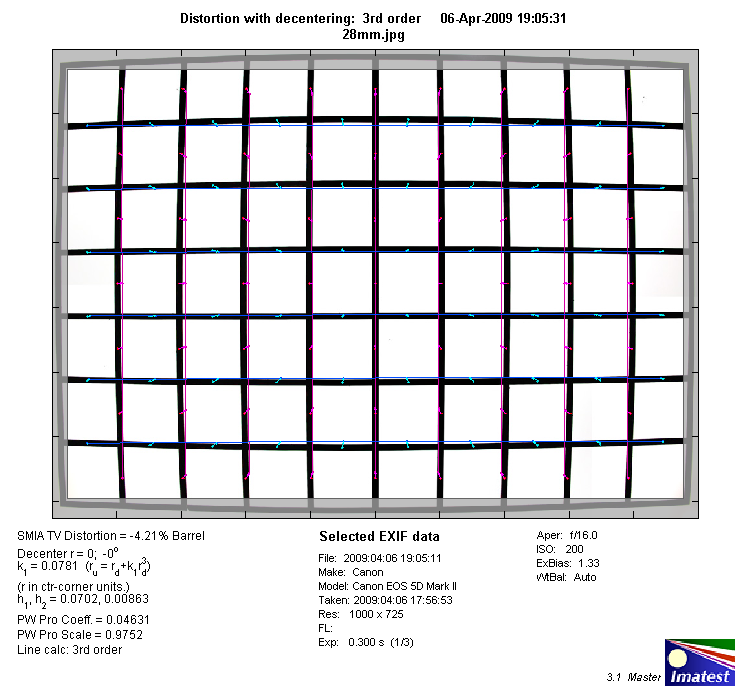
We have already tested the lens in the APS-C DSLR scope before and it did convince here with respect to distortion. However, on a full format DSLR the situation isn't quite as rosy - at least at 28mm where you can experience a fairly extreme degree of barrel distortion (4.2%). The problem eases significantly beyond this setting with only moderate pincushion distortion around ~1% from 50mm onwards.
|
Move the mouse cursor over the focal length text marks below to observe the respective distortion
|
| 28mm |
50mm |
100mm |
200mm |
300mm |
|
|
Vignetting
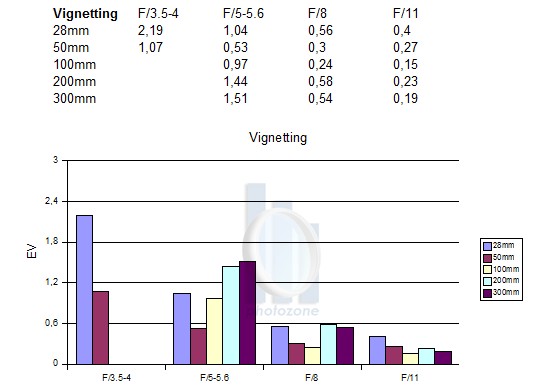
Typical for most full format lenses the EF 28-300mm f/3.5-5.6 USM L IS has significant problems with respect to vignetting at max. aperture. This is especially true for 28mm @ f/3.5 (2.2EV) and 200/300mm @ f/5.6 (~1.5EV). As usual it helps to stop down and the situation is acceptable by f/5.6-8 at the wide end and f/8 for long tele settings. All-in-all this is not great but not worse than much shorter zoom lenses either.
MTF (resolution)
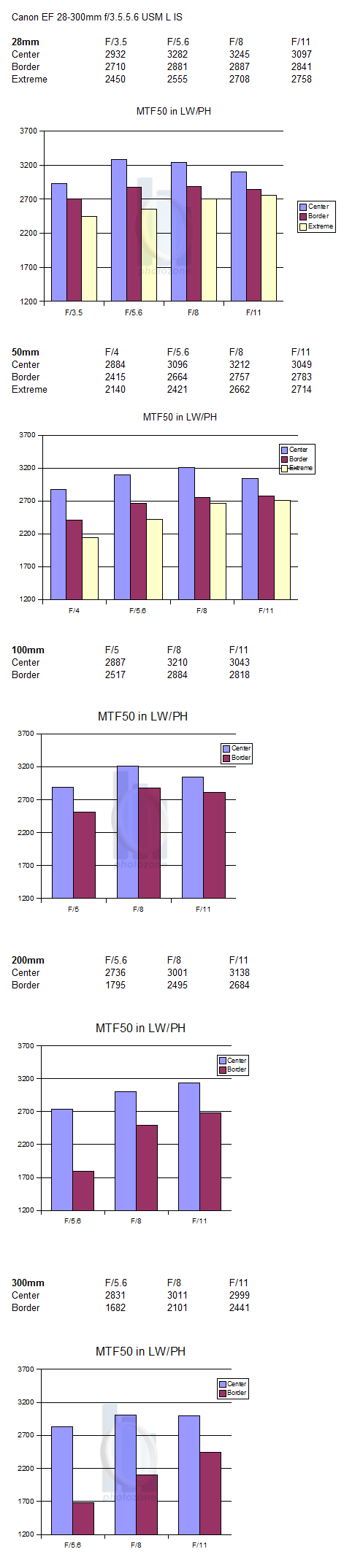
With respect to its extreme 10.7x zoom ratio the EF 28-300mm L IS is obviously a lens of compromises and regardless of all efforts it cannot be a stellar performer. However, the lens manages to keep the quality on a very respectable level throughout a good portion of the zoom range. The resolution figures are surprisingly decent at 28mm where the center and border quality is high straight from the max. aperture. Even the extreme corner are very usable here. The sweet spot of the lens is around 50-100mm especially at medium aperture settings.
There's a quite significant drop in quality at 200mm and 300mm - less so in the image center but the borders are very soft at large apertures and the contrast could also be better at f/5.6. If possible you should use at least f/8 here - not only for a better resolution but also to increase the contrast performance. The local peak (very good center, good borders) is reached at f/11.
Please note that the MTF results are not directly comparable across the different systems!
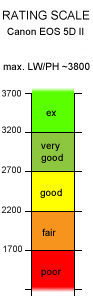
Below is a simplified summary of the formal findings. The chart shows line widths per picture height (LW/PH) which can be taken as a measure for sharpness.
If you want to know more about the MTF50 figures you may check out the corresponding Imatest Explanations
Chromatic Aberrations
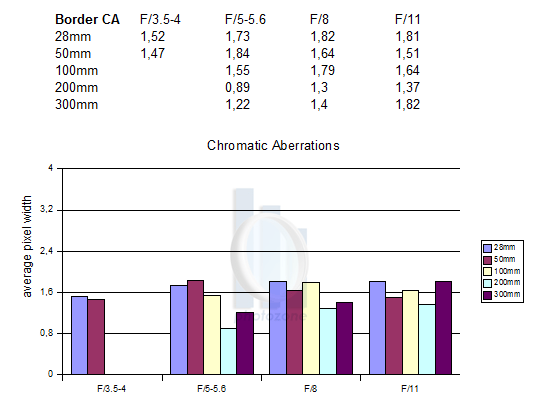
Chromatic aberrations (color shadows at harsh contrast transitions) quite well under control for such a lens with a maximum around 1.5px on the average throughout most of the range. This is naturally still visible at times when looking at images at 100% magnification but it's not really significant for prints and tools like Canon's DPP can correct the problem during RAW conversions on-the-fly.
|