|
Sigma AF 12-24mm f/4.5-5.6 HSM DG II - APS-C Format Review / Lab Test Report - Analysis |
|
Lens Reviews -
Canon EOS (APS-C)
|
|
Page 2 of 2

Distortion
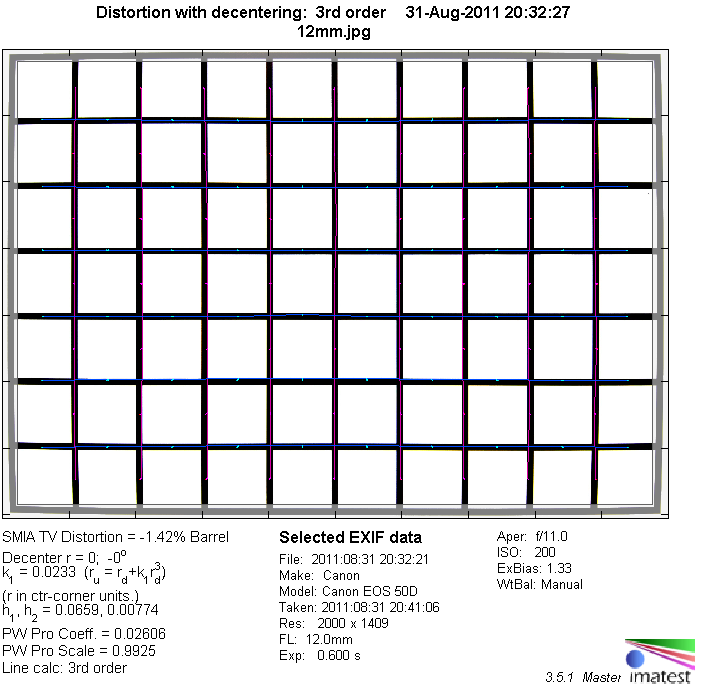
The Sigma lens produced quite some distortion in our full format test but the issue eases significantly on APS-C cameras - remember that most of the "action" occurs in the outer image zones and these are simply cropped within this scope. At 12mm there's only a moderate degree of barrel distortion (1.6%) which is better than average at such a wide setting. The characteristic changes to a slight pincushion distortion at 17mm and 24mm.
|
Move the mouse cursor over the focal length text marks below to observe the respective distortion
|
| 12mm |
17mm |
24mm |
|
|
Vignetting
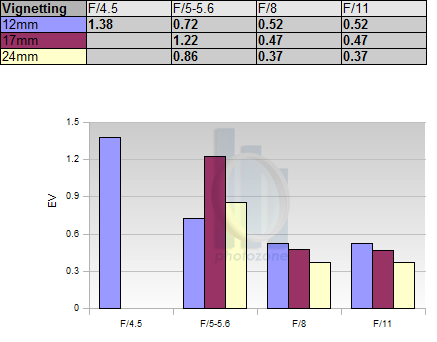
You may have hoped that the Sigma shows only a moderate light falloff due to the sweet spot advantage on the smaller format. However, while the issue is certainly much reduced compared to the full format results the vignetting is still comparatively high (~1.4EV) on APS-C cameras - specifically at 12mm at f/4.5. It is therefore a good idea to stop down a little bit. Same goes for the 17mm setting. The amount of vignetting is lower (~0.9EV) at 24mm fully open but it helps to stop down by 1 f-stop here as well.
MTF (resolution)
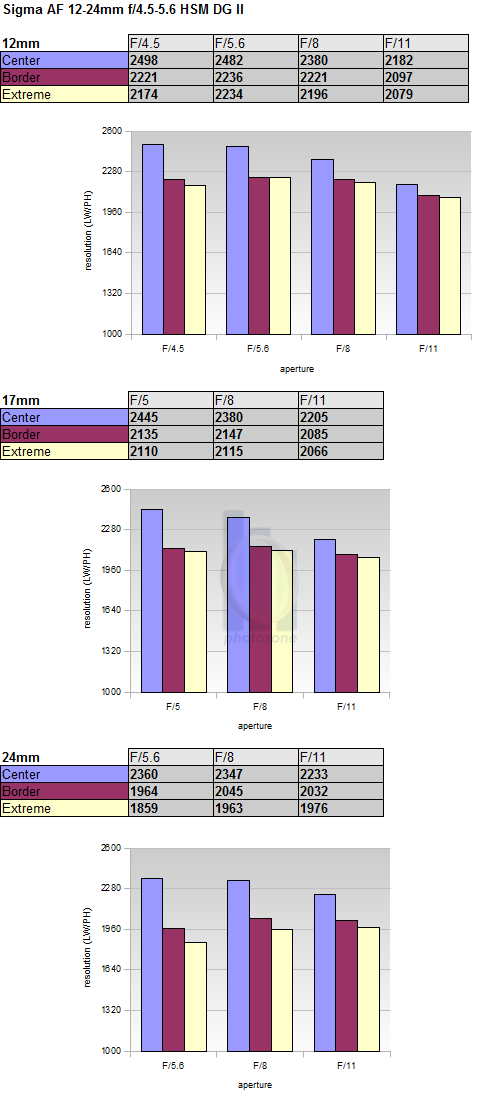
The resolution figures of the Sigma are impressive on the smaller format. This is especially true for the 12mm setting where the lens is capable of delivering very sharp results straight from f/4.5. The center quality is excellent in the relevant aperture range till f/8 and borders and corners are easily very good here. Diffraction has a slightly higher impact in the image center at f/11 but the general quality remains very high. The image quality is similar at 17mm albeit on a marginally reduced level. There's a slightly higher quality penalty at 24mm but the center is still excellent till f/8 whereas the borders/corners are "only" good to very good.
The field curvature is low to moderate and not objectionable - this issue is more significant on full format cameras though.
Please note that the MTF results are not directly comparable across the different systems!
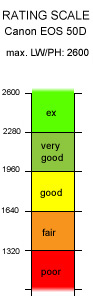
Below is a simplified summary of the formal findings. The chart shows line widths per picture height (LW/PH) which can be taken as a measure for sharpness.
If you want to know more about the MTF50 figures you may check out the corresponding Imatest Explanations
Chromatic Aberrations (CAs)
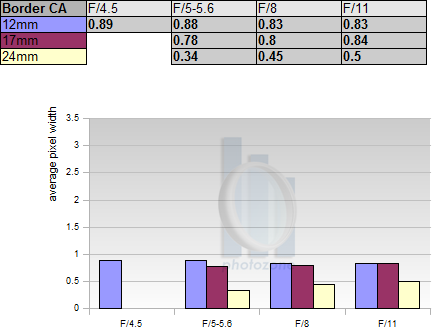
The effect of Sigma's new FLD glass is most obvious regarding lateral CAs (color shadows at the image borders). The mark I lens produced a very heavy amount of those and the recently tested Tokina AF 11-16mm f/2.8 AT-X Pro DX had its share of problems as well. The Sigma AF 12-24mm f/4.5-5.6 HSM DG II has no real issues here. The lateral CAs remain well below 1px on the average at the image borders. While sometimes visible at 100% image view this is hardly objectionable anymore.
VerdictThe Sigma AF 12-24mm f/4.5-5.6 HSM DG II is the only "one size fits all" (formats) ultra-wide zoom lens on the market. It can give you decent results and truly extreme views on full format DSLRs and it is very good along across the more "conventional" zoom range on APS-C DSLRs. On the "crop" format it shows very few weaknesses. At 17mm and especially 12mm it is very sharp across the image frame and the quality is still good to very good at 24mm. The vignetting is a bit on the high side at fully open aperture but that's rather typical for an ultra-wide lens anyway. The distortion characteristic is very moderate with only a moderate barrel distortion at 12mm and slight pincushion distortions in the mid to longer focal length range. The benefits of the new lens design are most obvious with respect to lateral CAs. They were a real issue on the mark I version but they are no longer relevant with the mk II.
Compared to "the rest of the gang" the Sigma AF 12-24mm f/4.5-5.6 HSM DG II is significantly bigger and heavier - e.g. versus the Tokina AF 12-24mm f/4 AT-X Pro DX we are talking about 25% more here ... at a slower speed. The Sigma lens is also more expensive but this is simply the price to pay for the full format potential. The build quality of the Sigma is on a very high level and the AF is both fast and nearly silent. As usual we'd like to point out that you should be careful regarding the use of AF on ultra-wide lenses because you will ultimately waste a lot of depth-of-field upon a naive use - just remember the hyper-focal distance. Anyway, as a solution for both APS-C and full format cameras the Sigma is an obvious choice. If you stick to APS-C cameras it will be too expensive and too big & heavy - something like the Canon EF-S 10-22mm f/3.5-4.5 USM or Sigma AF 8-16mm f/4.5-5.6 HSM DC would make more sense then.
| Optical Quality: |
 to to  |
|
|
| Mechanical Quality: | |
| Price/Performance (cross format): |  |
| Price/Performance (APS-C only): |  |
| | |
| | What does this mean ? |
|