|
Sigma AF 50mm f/1.4 EX DG HSM (Canon) - Full Format Review / Test Report - Analysis |
|
Lens Reviews -
Canon EOS (Full Format)
|
|
Page 2 of 2

Distortion
The Sigma produces a moderate degree of barrel distortion (1.7%) on full format cameras. This may be visible at time although it's far from being extreme.
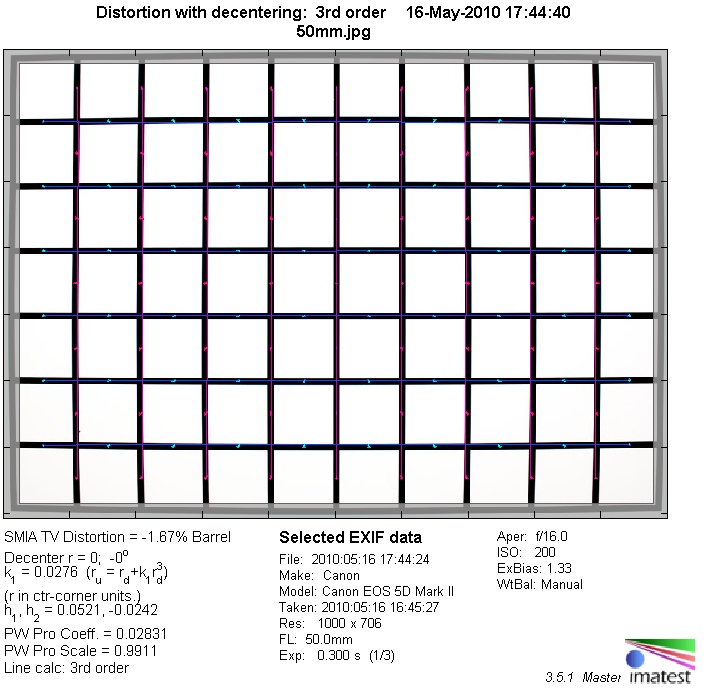
The chart above has a real-world size of about 120x80cm.
Vignetting
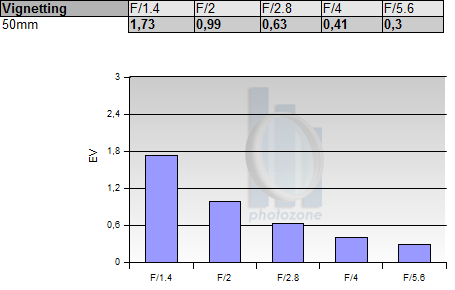
Typical for ultra-large aperture lenses there's quite a bit of vignetting at max. aperture. You will notice this (~1.7EV) in field images. The situation eases at f/2 but you will need to stop down to f/2.8 till the problem is really well controlled.
MTF (resolution)
The Sigma produced fairly typical resolution figures for such a lens. The lens is very sharp in the image center at f/1.4 but the borders/corners are poor on full format images here. The quality increases gradually when stopping down. The center is starting to show excellent results at f/2 and it's downright outstanding from f/2.8 to f/5.6 onwards. However, the borders/corners remain unimpressive at large apertures. You need to stop down to f/5.6 in order to get good results here and the quality does never reach very good levels. The global sweet spot is reached around f/8.
In the field the lens has some trouble at extremely close focus distances and large aperture settings.
Please note that the MTF results are not directly comparable across the different systems!
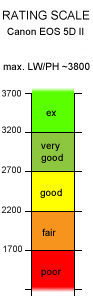
Below is a simplified summary of the formal findings. The chart shows line widths per picture height (LW/PH) which can be taken as a measure for sharpness.
If you want to know more about the MTF50 figures you may check out the corresponding Imatest Explanations
Chromatic Aberrations (CAs)
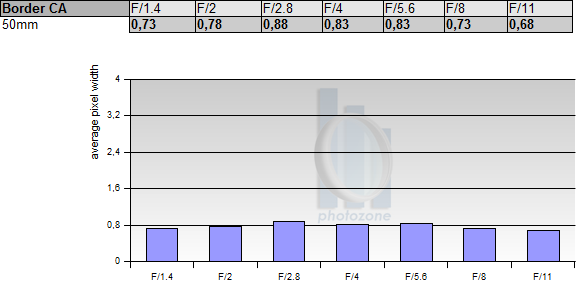
Lateral chromatic aberrations (color shadows at harsh contrast transitions) are generally moderate with an average pixel width around 0.8px at the image borders. This is very good in the full format scope and only marginally worse compared to our APS-C test.
Bokeh
The quality of the bokeh (out-of-focus blur) is a primary aspect for such a large aperture lens. The Sigma can produce good results but it has some flaws here. The background blur is smooth and buttery but the foreground can be very nervous at large apertures.
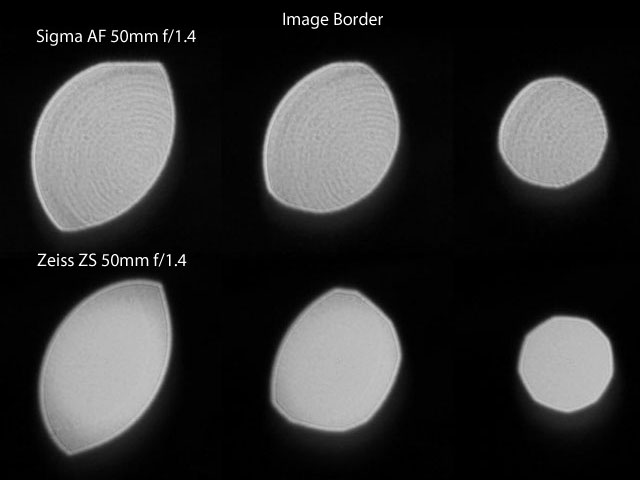
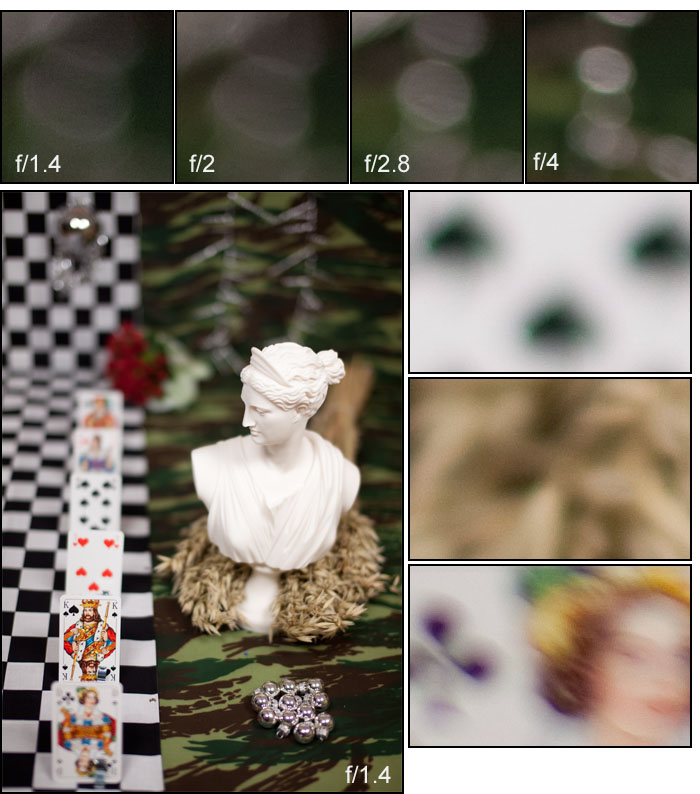 The rounded aperture shape in out-of-focus highlights remains pretty much intact all the way up to f/4 - that's in the center. In the image corners the disc deteriorate towards a "cat's eye" characteristic which is, to be fair, quite normal. At large aperture settings there're also traces of onion-like structures.
We've prepared some sample crops illustrating the out-of-focus highlight characteristic compared to the Zeiss ZS 50mm f/1.4
Image center @ f/1.4, f/2 and f/2.8:
The rounded aperture shape in out-of-focus highlights remains pretty much intact all the way up to f/4 - that's in the center. In the image corners the disc deteriorate towards a "cat's eye" characteristic which is, to be fair, quite normal. At large aperture settings there're also traces of onion-like structures.
We've prepared some sample crops illustrating the out-of-focus highlight characteristic compared to the Zeiss ZS 50mm f/1.4
Image center @ f/1.4, f/2 and f/2.8:
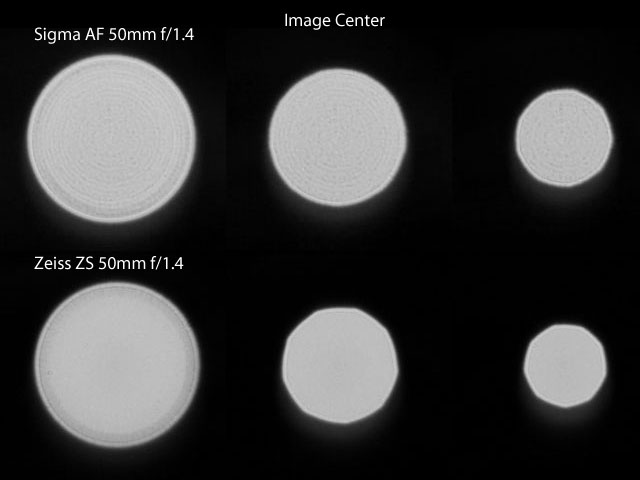 The Sigma is a little superior to the Zeiss in keeping a circular shape whereas the Zeiss shows a "cleaner".
Image corner @ f/1.4, f/2 and f/2.8:
The Sigma is a little superior to the Zeiss in keeping a circular shape whereas the Zeiss shows a "cleaner".
Image corner @ f/1.4, f/2 and f/2.8:
 Both lenses don't really shine here. Regarding the very large front element we expected a better behavior of the Sigma here but it isn't really any better.
Longitudinal (Axial) Chromatic Aberrations (LoCA)
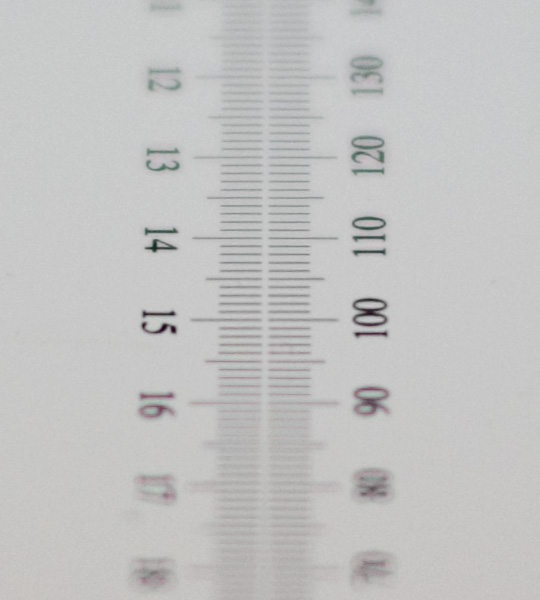
LoCAs (non-coinciding focal planes of the various colors), sometimes called "bokeh CAs", are a general problem in this lens class. As you can notice below the halos have different colors - magenta (red + blue) in front the focus point and green beyond. The Sigma does a comparatively good job here though. The problem is visible but although not overly disturbing at f/1.4 and at f/2 it is usually not field-relevant anymore.
Please note that we've to use a fairly close focus setting for these tests. As mentioned the lens has some softness issues in such a scenario which is why the sample crop doesn't look overly impressive at f/1.4 and f/2.
Upon closer observation you may notice that the focus shifts towards the back when stopping down ("Residual spherical aberrations") - especially from f/2 to f/2.8.
|
Move the mouse cursor over the f-stop marks below to observe the respective LoCAs
|
| f/1.4 |
f/2 |
f/2.8 |
f/4 |
|
|
Verdict
The new Sigma AF 50mm f/1.4 EX DG HSM showed pretty impressive results in our APS-C review. However, it's not quite as convincing on full format cameras. The center quality of the lens is certainly fine and even great from f/2 onwards. Unfortunately the border & corner performance is rather disappointing. It's downright soft at large apertures and never really better than good even at the very best setting (f/8). The amount of vignetting is quite heavy at f/1.4 but that's rather typical for such lenses. If you stop down to f/2.8 this will not be a real issue anymore though. The lens produces moderate barrel distortions which is a tad more than the standard in this lens class. Lateral CAs are very well controlled and not really field relevant. The bokeh is quite decent although not perfect either.
A real highlight of the lens is certainly its build quality. Unlike most 50mm f/1.4 it features a metal body and a good focus ring. The HSM AF drive is very fast and virtually silent. Unfortunately the lens suffers from residual spherical aberrations (focus shifts) when stopping down so accurate focusing can be tricky.
| Optical Quality: |
 |
|
| Field Quality: |  (Low light-/Shallow Depth-of-Field Photography) (Low light-/Shallow Depth-of-Field Photography) |
| Mechanical Quality: |  |
| Price/Performance: |  |
| | |
| | What does this mean ? |
|