|
Canon EF-S 18-55mm f/3.5-5.6 IS - Retest @ 15MP / Review - Analysis |
|
Lens Reviews -
Canon EOS (APS-C)
|
|
Page 2 of 2

Distortion
The data has been taken from the old review because this characteristic cannot change when moving to a different sensor with the same physical size.
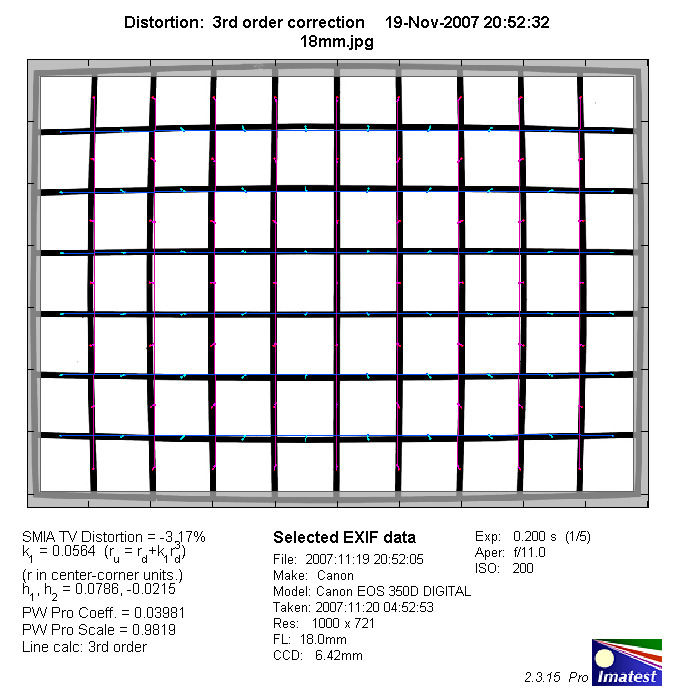
Typical for many APS-C standard zoom the EF-S 18-55mm f/3.5-5.6 IS produces very strong barrel
distortion at 18mm (~3.2%) changing to very mild (~0.2%) pincushion distortion at 55mm.
|
Move the mouse cursor over the focal length text marks below to observe the respective distortion
|
| 18mm |
28mm |
55mm |
|
The chart above has a real-world size of about 120x80cm.
Vignetting
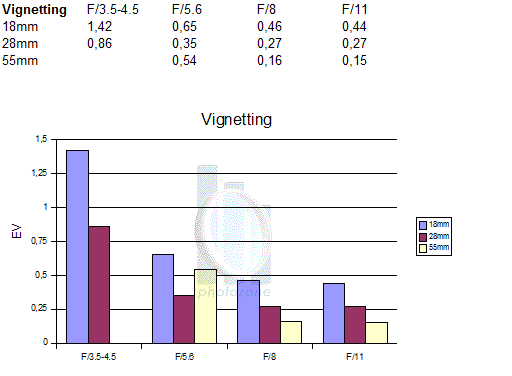
The Canon EF-S 18-55mm f/3.5-5.6 IS is a dedicated APS-C lens and these lenses tend to produce a
comparatively high degree of vignetting. At 18mm @ f/3.5 we're talking about ~1.4EV here which is
visible in many field images at this setting. The problem eases towards the
long end of the zoom range and it's generally not all that bad anymore at f/5.6 and a non-issue
beyond.
MTF (resolution)
The lens did already come up with a quite baffling performance in the old 8MP tests but it continues
to impress on the EOS 50D @ 15MP.
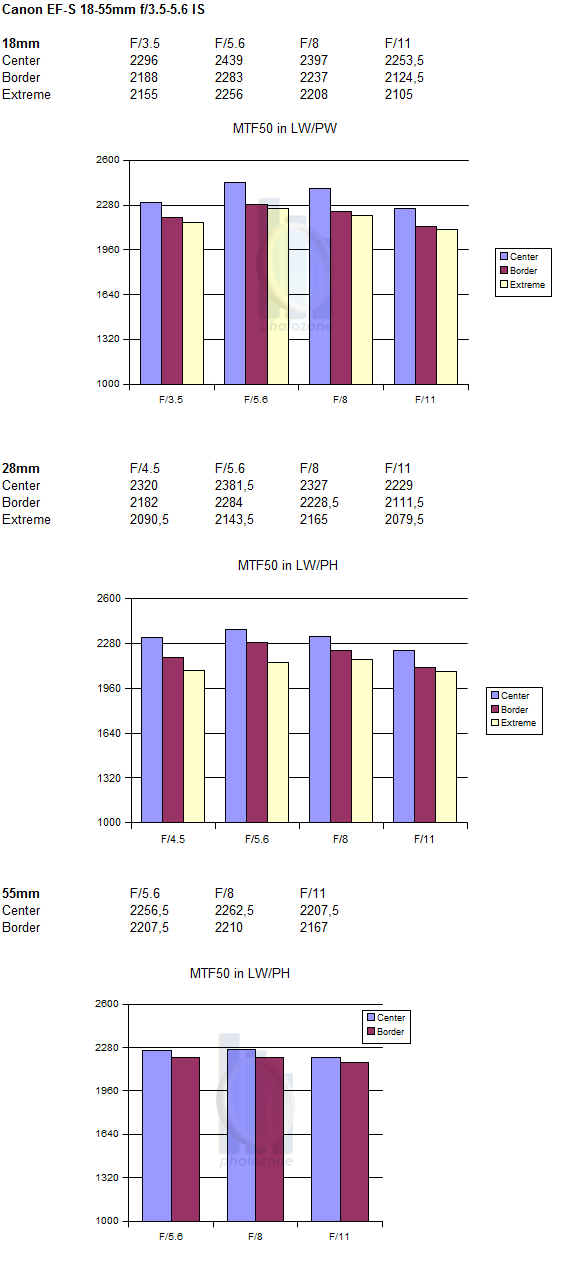
The center resolution of the lens is very high throughout the tested zoom and aperture
range although it does no longer reach the limits of the sensor capabilities anymore.
Normally you would expect a severe drop off beyond the inner image portion
but this is not the case. The border and even the extreme corners remain on a very good level
especially at 18mm. This is not unprecedented - the Nikkor AF-S 18-55mm f/3.5-5.6 ED is also
darn good for instance - but it's certainly something new for a budget Canon standard zoom lens.
Please note that the MTF results are not directly comparable across the different systems!
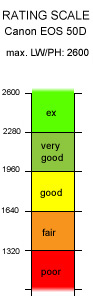
Below is a simplified summary of the formal findings. The chart shows line widths per picture height (LW/PH) which can be taken as a measure for sharpness.
If you want to know more about the MTF50 figures you may check out the corresponding Imatest Explanations
Chromatic Aberrations (CAs)
The level of lateral chromatic aberrations (color shadows at harsh contrast transition) is varying
throughout the zoom range. At 18mm the CAs stay around 1.5px on the average at the image borders which
is surprisingly well controlled compared to higher priced standard zoom lenses at this setting.
In the middle range the CAs are quite significant peaking beyond 2px at medium aperture settings.
At 55mm the problem decreases again to very acceptable levels.

VerdictThe resolution capabilities of the Canon EF-S 18-55mm f/3.5-5.6 IS is amazing even based on the EOS 50D.
The lens resolution may no longer reach the limits of the sensor resolution (as it did on the EOS 350D)
but the quality level remains very high throughout the zoom range. Even more surprising is the evenly
high corner to corner performance. So is it a perfect lens then ? No, naturally not. It has its weaknesses - notably
strong barrel distortions at 18mm and very high vignetting at 18mm @ f/3.5. Chromatic aberrations are well
controlled at the extreme ends of the zoom range but quite pronounced around 28mm. In the field the lens
struggles in contra light situations whereas the bokeh (out-of-focus blur) is pretty good within the limits
of its depth-of-field capabilities. All-in-all the optical aspects are impressive and that's not only
regarding the low price tag. The image stabilizer is quite efficient with a real world "gain" equivalent
to about 3 f-stops. On the mechanical side things aren't so rosy. Canon changed the cosmetics of the lens
and it certainly "looks" better now but the actual implementation has only been marginally improved compared
to the EF-S 18-55mm f/3.5-5.6 II. The plastic quality (down to the lens mount) spoils the subjective quality
perception quite a bit. The inner lens tube does still wobble significantly and accurate manual focusing
remains next to impossible. However, the AF speed and accuracy is very decent and that's probably good enough
for most users anyway. The Canon EF-S 18-55mm f/3.5-5.6 IS is certainly a value king with a price tag
of around 160€/US$.
| Optical Quality: |  |
| Mechanical Quality: |  |
| Price/Performance: |  |
|