|
Peleng 8mm f/3.5 Fisheye (converted to EOS mount) - Review / Test Report - Analysis |
|
Lens Reviews -
Canon EOS (APS-C)
|
|
Page 2 of 3
Distortion
Well, it's a fisheye so what do you expect ? :-) I can´t even provide hard
distortion figures here because the analysing tool didn´t like the fisheye
effect on the grid chart. Anyway, the image below should give you an idea.
BTW, the distortion chart below has a size of 120x80cm and the image was taken
at a distance of ~2cm (!!!).
You may notice that the fisheye effect of the Peleng is far more pronounced
compared to the Canon EF 15mm f/2.8 Fisheye.
|
Move mouse cursor over the image to
have a look at the real-life distortion chart.
 |
Vignetting
Due to the circular fisheye character it is pointless to provide
any vignetting data.
On APS-C DSLR you will notice dark outer edges. This is no vignetting
but simply the effect of the cropping factor. Stopping down does
not improve the issue.
MTF (resolution)
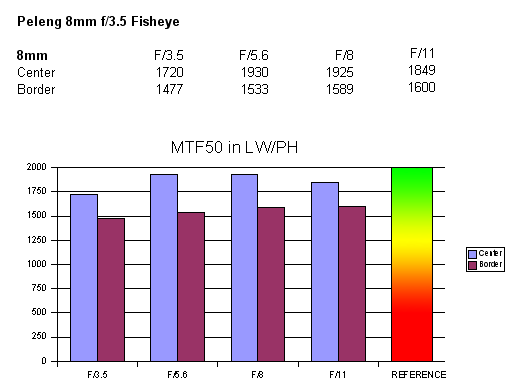
It was a little difficult to obtain valid resolution data with this lens
but it seems to perform surprisingly well here with a very good center
performance and pretty good edges (except at the extreme corners
of the circular image field).
Please note that the MTF results are not directly comparable across the different systems!
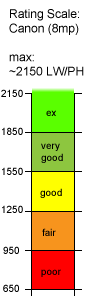
Below is a simplified summary of the formal findings. The chart shows line widths per picture height (LW/PH) which can be taken as a measure for sharpness.
If you want to know more about the MTF50 figures you may check out the corresponding Imatest Explanations
Chromatic Aberrations (CAs)
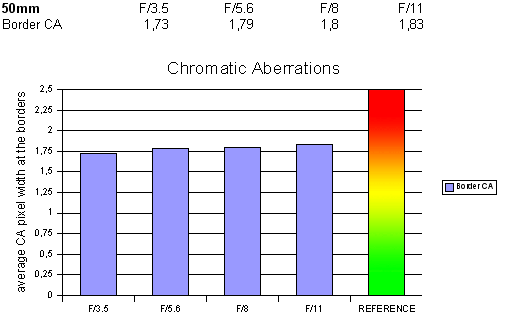
Formally chromatic aberrations (color shadows at harsh contrast transitions) are
very pronounced exceeding 1.5 pixels on the average at the image borders. However,
this can really be considered as a side issue regarding the special effect
character of this fisheye lens.
Due to it rather extreme depth-of-field a bokeh can only be observed at
very close focus distances. If forced to produce a blurred background it
seems to do a pretty decent job here.
The major weakness of this lens is flare. Due to the protruding front
element it does so like hell. Even an overcast day is sufficient to
produce ghostings.
|