|
Page 2 of 2
Distortion
Such long range zoom lenses tend to suffer from rather hefty distortion but the AF-S 16-85mm VR does a comparatively good job here. Unsurprisingly it shows relatively pronounced barrel distortion at 16mm (~2.5%) but we've seen worse things here. At 24mm the opposing forces even out whereas you get moderate pincushion distortion (~1%) beyond. All-in-all a good performance for a standard zoom lenses.
|
Move the mouse cursor over the focal length text marks below to observe the respective distortion
|
| 16mm |
24mm |
35mm |
50mm |
85mm |
|
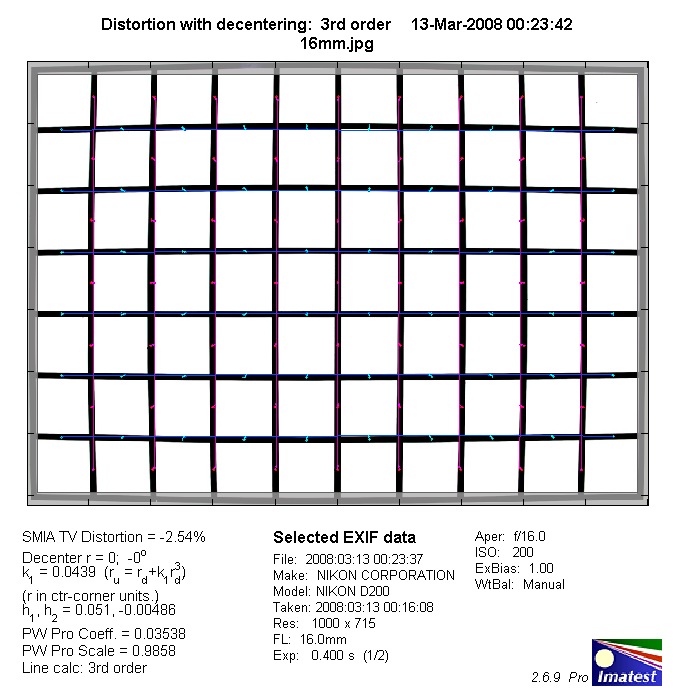
|
The chart above has a real-world size of about 120x80cm.
Vignetting
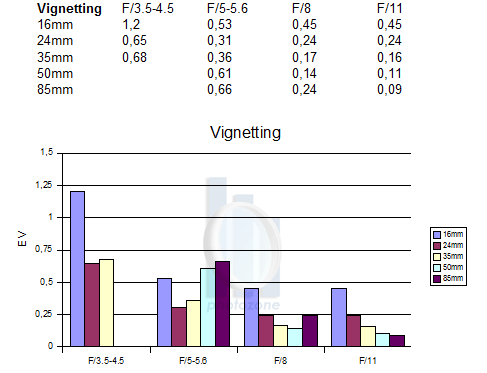
The AF-S 16-85mm DX is a reduced image circle (APS-C) lens so vignetting is naturally more pronounced compared to full format lenses used on DX DSLRs. Typical for such standard zoom lenses the vignetting is worst at the wide end (16mm @ f/3.5) where it exceeds 1.2EV so stopping down to f/5.6 is advisable here. The situation eases significantly beyond the wide end.
MTF (resolution)
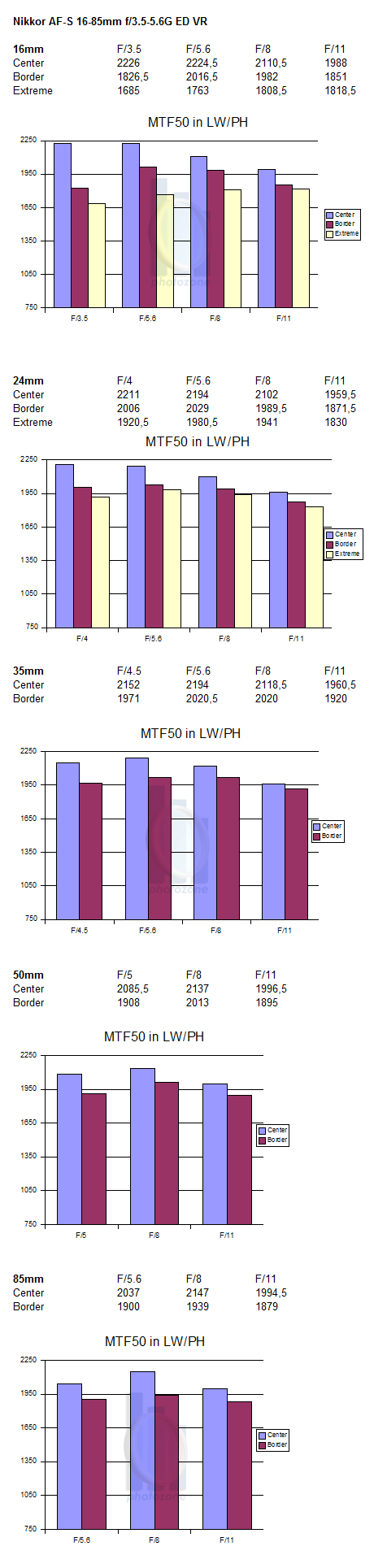
The resolution characteristic of the Nikkor is impressive. Unsurprisingly the "weakest" performance is at 16mm - the center quality is about as good as it gets whereas the borders and extreme corners are on a very good level within the focus zone. However, the lens suffers from some field curvature in the extreme corners and there's also a bit of a focus shift when stopping down (residual spherical aberrations). Regarding the vignetting problems it is a good idea to stick to f/8 here anyway. The border quality as well as the field curvature issue improves at 24mm and the sweet spot of the lens is reached around 35mm with a next to perfect characteristic across the frame. There's a slight drop at 50mm and 85mm but the quality remains on a very high level here.
The centering quality is generally decent although it deteriorates a little towards the long end of the range - not really surprising regarding the combined VR/duo-cam design. That said the problem surely remains within specifications and there was no reason to reject the tested lens sample (around 15% of the tested lenses are rejected here at PZ).
Please note that the MTF results are not directly comparable across the different systems!
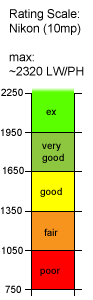
Below is a simplified summary of the formal findings. The chart shows line widths per picture height (LW/PH) which can be taken as a measure for sharpness.
If you want to know more about the MTF50 figures you may check out the corresponding Imatest Explanations
Chromatic Aberrations (CAs)
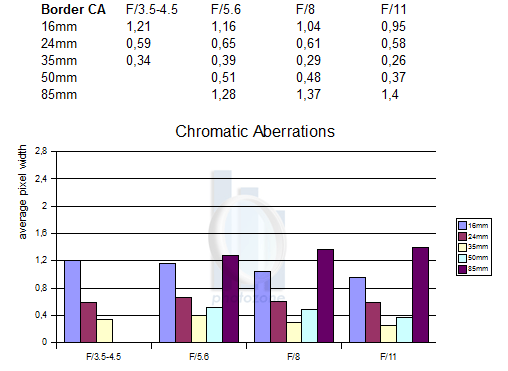
Cameras like the D300 or Nikon Capture NX (RAW converter) may take care of lateral Chromatic aberrations (color shadows at harsh contrast transitions) but naturally it remains a defect worth to be mentioned. The CAs are pretty well controlled for most of middle range but somewhat more pronounced at the extreme ends with an average width around 1.5px at the image borders. This is still quite decent for a standard zoom lens.
Bokeh
I suspect that the findings in this chapter will generate somewhat controversial discussions. However, before going into details I should clearly mention that a 16-85mm f/3.5-5.6 is not really meant to be used in shallow depth-of-field situations - the slow max. aperture is simply not suitable for this. Naturally you can produce a shallow DOF by choosing a very close focus distance but that's pushing things a little. Anyway ...
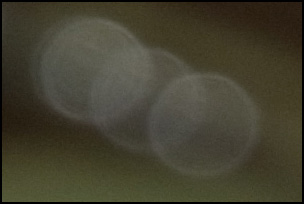
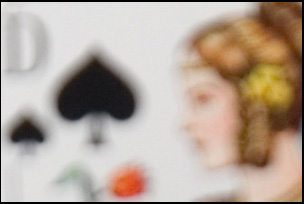
Normally I would not even have bothered to look into this for such a lens but some sample images on the web made me wonder a little. During the field tests I obtained several sample images at 85mm f/5.6 but I didn't really find something out of the ordinary. The bokeh (the quality of the out-of-focus blur) may not be something special here but it's acceptable both for highlights as well as regarding the general blur.
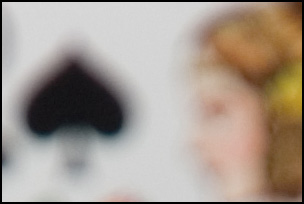
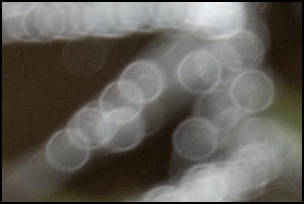
However, the situation changes rather dramatically when moving towards 50mm f/5:
The blur is quite busy here (shape shadows) and the outlining effect around highlights is plain terrible - almost similar to mirror lens.
Again - regarding the typical applications for such a lens you shouldn't blow this out of proportions but it's something to keep in mind here.
Verdict
Despite some shortcomings the Nikkor AF-S 16-85mm f/3.5-5.6G ED VR DX is probably still the best DX standard zoom lens in Nikon mount to date. It is very sharp throughout the range although there could be a little less field curvature (curved focus field) at 16mm. The level of distortions and lateral CAs is comparatively moderate for such a lens (still a bit high in absolute terms). Vignetting is generally well controlled except at 16mm @ f/3.5. The rather slow max. aperture may be a bit unfortunate because the achievable bokeh is rather underdeveloped in conventional scenes. If you're after a (relatively) shallow depth-of-field you should also stick to the 85mm setting - the bokeh is rather harsh at 50mm f/5. The VR II (Vibration Reduction) can help to safe the day in low light situations (at cost of shutter speed) with a "gain" of ~3 f-stops in field conditions.
The build quality is on a good level but don't expect professional grade quality here. All-in-all an obvious choice but not flawless ... which is why I had to agonize a while about the optical rating but I believe that the lens is somewhat more desirable than the AF-S 17-55mm f/2.8G ED although it's a bit like comparing apples and oranges here.
|